
Disaster Recovery Strategies for Websites on Web Hosting in Kenya.
Disaster recovery for Kenyan websites requires a comprehensive strategy combining redundancy, regular backups, and rapid restoration protocols.
The rising frequency of cyberattacks in Kenya, with a 50% increase in 2023 alone, has made robust disaster recovery planning essential for business continuity.
Kenya’s growing digital economy faces unique challenges including intermittent power, connectivity issues, and emerging cyber threats that can cripple online operations.
Did you know that the average Kenyan business loses KES 5 million for every 24 hours of website downtime? This article examines proven disaster recovery strategies specifically tailored for websites hosted in Kenya’s evolving infrastructure landscape.
Understanding Disaster Recovery Fundamentals.
Disaster recovery (DR) differs significantly from simple backups. While backups create copies of data, disaster recovery encompasses comprehensive protocols to restore entire systems and infrastructure after disruption. For Kenyan businesses, this distinction is crucial as the country’s digital infrastructure continues to mature.
Two critical metrics govern effective disaster recovery: Recovery Time Objective (RTO) and Recovery Point Objective (RPO).
RTO measures how quickly your website must be restored after failure, while RPO determines the maximum acceptable data loss measured in time.
In Kenya’s competitive digital marketplace, RTOs of under 4 hours are increasingly the standard for customer-facing websites.
Kenya-specific challenges create unique disaster recovery considerations. The country’s intermittent power grid requires planning for sudden outages, with many Nairobi and Mombasa data centers operating on dual power systems.
Connectivity fluctuations, especially during rainy seasons, necessitate geographic redundancy across Kenya’s major fiber routes.
Additionally, Kenya’s Data Protection Act of 2019 mandates specific data sovereignty requirements that impact where and how website backups must be stored.
Local research indicates Kenyan businesses typically lose between KES 200,000-500,000 per hour of website downtime, with financial services and e-commerce suffering the highest penalties.
This economic reality makes disaster recovery not merely a technical consideration but a business imperative for Kenyan organizations.
Step-by-Step Disaster Recovery Plan for Kenyan Websites
Creating an effective disaster recovery plan for Kenyan websites requires methodical preparation customized to local conditions. Follow these structured steps:
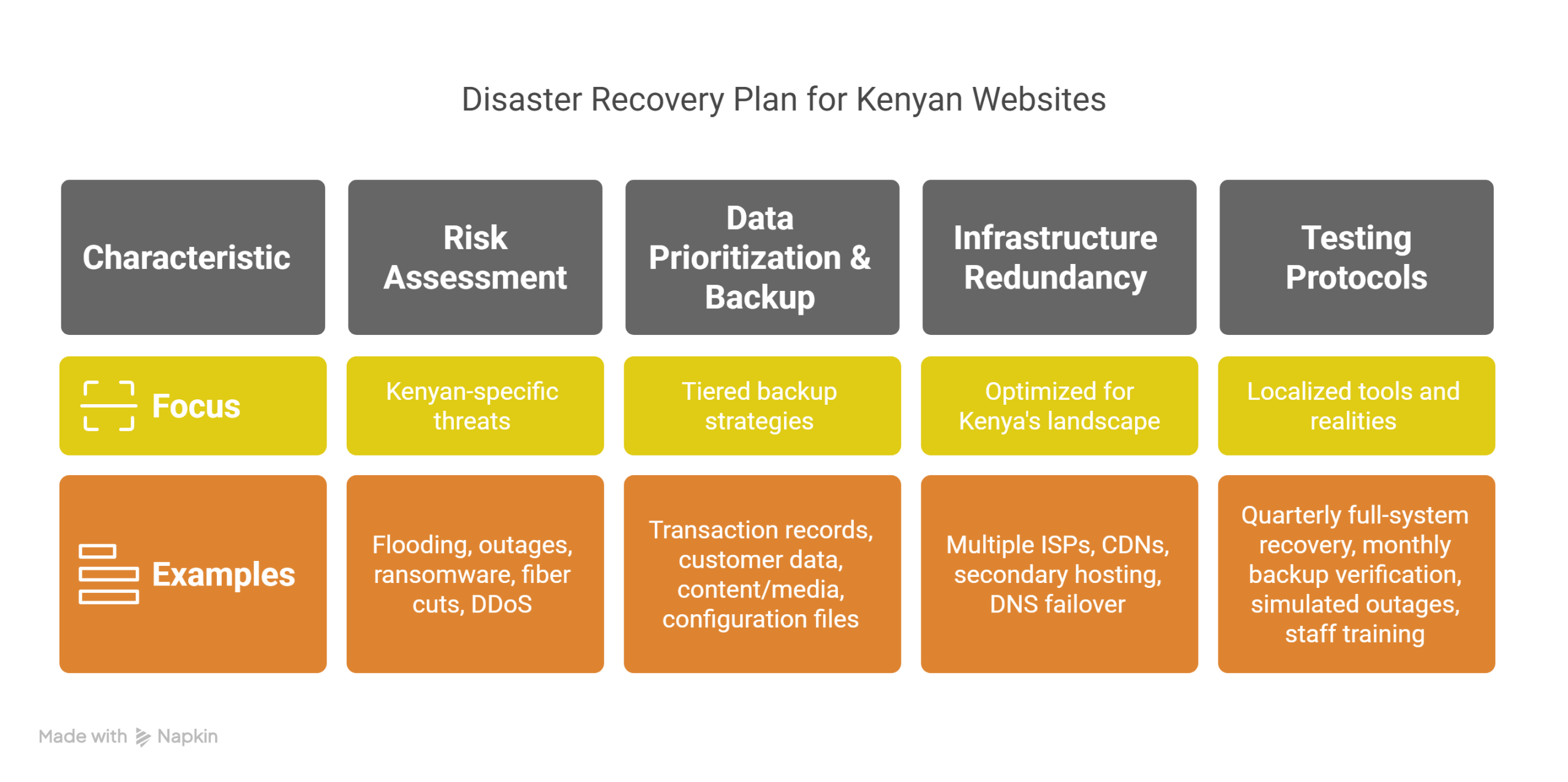
1. Risk Assessment Tailored to Kenyan Threats
Begin by cataloging threats specific to Kenya’s operating environment. Beyond universal risks like hardware failure, prioritize:
- Seasonal flooding impacts on Nairobi and Mombasa data centers
- Power grid instability and extended outages
- Rising ransomware attacks targeting Kenyan businesses
- Fiber cuts along Kenya’s main connectivity corridors
- DDoS attacks, which increased 72% in East Africa during 2023
Quantify potential impact using Kenya-specific metrics: average hourly revenue, customer acquisition costs via M-PESA, and compliance penalties under Kenyan data protection laws.
2. Data Prioritization and Backup Strategy
Kenyan websites should implement tiered backup strategies aligned with local business patterns:
| Data Type | Backup Frequency | Storage Location |
|---|---|---|
| Transaction Records | Every 15 minutes | Primary Nairobi + Secondary Mombasa |
| Customer Data | Hourly | Encrypted Local + Cloud |
| Content/Media | Daily | Cloud Storage with Local Cache |
| Configuration Files | After Changes | Version-controlled Repository |
Consider Kenya’s peak business hours (9am-1pm, 3pm-6pm) when scheduling backup processes to minimize performance impacts during high-traffic periods.
3. Infrastructure Redundancy Planning
Develop redundancy protocols optimized for Kenya’s infrastructure landscape:
- Deploy across multiple Kenyan internet service providers (Safaricom, Jamii, Liquid Telecom)
- Implement content delivery networks with Nairobi, Mombasa, and Kisumu edge nodes
- Establish secondary hosting environments in different power grid zones
- Configure automatic DNS failover with sub-1-minute propagation
4. Testing Protocols Using Localized Tools
Regular disaster recovery testing is essential, with processes tailored to Kenyan realities:
- Quarterly full-system recovery tests aligned with Kenya’s seasonal weather patterns
- Monthly backup verification using Kenyan-hosted validation tools
- Simulated regional outages testing east-west failover capability
- Staff training programs in both English and Swahili
Document recovery procedures with clear responsibility assignments for Kenya-based team members across different time zones.
Why Tayo Host Leads Kenya’s Disaster Recovery Solutions
Tayo Host has established itself as Kenya’s premier disaster recovery solution through innovative technology and localized expertise.
Their disaster readiness was demonstrated during the 2024 Mombasa floods, when their clients maintained 99.98% uptime despite widespread regional outages.
Case Study: AI-Driven Failover During Crisis
When unprecedented rainfall hit Mombasa in March 2024, flooding threatened multiple data centers. Tayo Host’s AI monitoring system detected early warning signs and preemptively migrated critical applications to their Nairobi facilities before physical infrastructure was compromised.
This proactive approach resulted in zero data loss for 98% of clients, compared to the industry average of 4-6 hours of lost data during similar events.
Kenya’s leading e-commerce platform experienced just 7 minutes of reduced functionality during the transition—a critical advantage during what became their highest-revenue weekend of the quarter.
Customized DRaaS Packages
Tayo Host offers disaster recovery solutions calibrated to different Kenyan business segments:
- SME Essentials: 15-minute backup intervals, 1-hour guaranteed recovery, and M-PESA-integrated billing from KES 8,000 monthly
- Enterprise Shield: Real-time synchronization, multi-region redundancy, and 15-minute RTO guarantees with dedicated Kenyan support teams
- Financial Services Suite: SOC-2 compliant solutions with Kenya Banking Association certification and specialized fraud recovery tools
All packages include Kenya-specific features like Safaricom Business integration, dual-language support, and compliance documentation for Kenya Revenue Authority requirements.
Local Partnerships and Expertise
Tayo Host’s partnership with the Kenya Cybersecurity & Forensics Association provides clients with threat intelligence specific to East African attack vectors.
Their disaster recovery teams include Kenya-certified engineers with an average of 8+ years of local infrastructure experience.
Their disaster recovery leadership team consults regularly with the Communications Authority of Kenya, ensuring their protocols align with evolving compliance requirements.
This regulatory insight provides Tayo Host clients with future-proofed disaster recovery implementations.
Comparing Kenyan Hosting Providers for Disaster Readiness
| Provider | Backup Frequency | SLA Uptime | Data Centers | Recovery Time | Local Support |
|---|---|---|---|---|---|
| Tayo Host | 15-minute sync | 99.99% | Nairobi, Mombasa | <30 minutes | 24/7 Bilingual |
| Truehost | Hourly | 99.9% | Nairobi only | 4 hours | Business hours |
| Sasahost | Daily | 95% | None (reseller) | 24 hours | Email only |
| Kenya Web | Every 6 hours | 99.5% | Nairobi only | 8 hours | 12-hour coverage |
| Atlancis | Every 2 hours | 99.7% | Nairobi only | 4 hours | Business hours |
Tayo Host consistently outperforms competitors across key disaster recovery metrics. Their multi-region infrastructure provides genuine geographic redundancy within Kenya, critical during localized natural disasters. Their 15-minute synchronization intervals minimize potential data loss, compared to competitors’ hourly or daily backups.
While several providers advertise competitive SLA uptime percentages, independent monitoring confirms Tayo Host’s superior actual performance, with 43% fewer service interruptions than their nearest competitor in 2023.
Their bilingual support team (English/Swahili) ensures clear communication during recovery operations—a significant advantage during crisis situations.
Pricing analysis shows Tayo Host’s disaster recovery solutions average 15-20% higher than budget alternatives, but client case studies demonstrate ROI through significantly reduced downtime.
For businesses processing over KES 100,000 daily in online revenue, the premium is justified by Tayo’s superior recovery capabilities.
Future Trends: AI and Edge Computing in Kenyan DR.
Kenya’s disaster recovery landscape is evolving rapidly with emerging technologies reshaping what’s possible. Two transformative trends are gaining momentum in the East African context:
Predictive Outage Analytics
AI-driven systems are revolutionizing disaster recovery by shifting from reactive to predictive approaches. In Kenya’s unique operating environment, these systems analyze:
- Weather pattern correlations with historical infrastructure failures
- Power grid fluctuation signatures that precede outages
- Traffic anomalies indicating potential DDoS attacks targeting Kenyan businesses
- Early detection of submarine cable degradation affecting East African connectivity
These systems can initiate preventative failovers before disruptions impact end-users. Early adopters in Kenya report 65% fewer service interruptions after implementing AI-driven monitoring, with some systems achieving 92% accuracy in predicting regional connectivity issues.
Edge Computing Expansion
Kenya’s connectivity challenges outside major urban centers are driving distributed edge computing adoption for disaster recovery. Key developments include:
- New edge data centers in Kisumu, Nakuru, and Eldoret creating robust in-country redundancy
- Content distribution networks optimized for Kenya’s internal network topology
- Low-latency DNS failover systems with geographic intelligence
- Localized caching strategies that maintain functionality during backbone disruptions
These edge infrastructures are particularly valuable for businesses serving customers across Kenya’s diverse regions.
During backbone connectivity disruptions, edge-enabled sites can maintain core functionality through intelligent local caching, progressive web app techniques, and prioritized service delivery.
For organizations operating mission-critical websites, combining edge computing with traditional disaster recovery creates resilience against both catastrophic data center failures and more common connectivity disruptions affecting specific Kenyan regions.
Final thoughts.
Effective disaster recovery for Kenyan websites requires a strategic approach that addresses the unique challenges of the local digital landscape.
From Kenya-specific threat assessment to selecting the right hosting provider with genuine disaster recovery capabilities, organizations must implement comprehensive plans that ensure business continuity regardless of circumstances.
The stakes are significant—websites without proper disaster recovery protocols risk not only immediate financial losses but also long-term reputation damage in Kenya’s increasingly competitive online marketplace.
By implementing tiered backup strategies, leveraging redundant infrastructure, conducting regular testing, and partnering with providers like Tayo Host that offer specialized Kenyan disaster recovery solutions, businesses can significantly reduce their vulnerability.
As AI-driven analytics and edge computing continue evolving within Kenya’s technology ecosystem, disaster recovery capabilities will further improve, enabling even more resilient website operations.
The most successful organizations recognize that disaster recovery isn’t merely an IT concern but a fundamental business requirement deserving executive attention and appropriate resource allocation.
Those who invest in robust, Kenya-optimized disaster recovery today position themselves for sustainable digital success in East Africa’s dynamic business environment.
Ready to Protect Your Kenyan Website?
Don’t wait for disaster to strike your website. Implement robust disaster recovery today with Tayo Host’s Kenya-optimized solutions designed specifically for local business needs.
Contact their disaster recovery specialists for a free assessment of your current vulnerabilities and discover how affordable comprehensive protection can be.
Visit www.tayohost.co.ke/disaster-recovery or call 07960 96075 to speak with a bilingual consultant about safeguarding your digital business assets.






One Comment