Web Hosting Security Best Practices for Kenyan Financial Services Websites.
Implementing robust web hosting security measures is essential for Kenyan financial services websites to protect sensitive customer data and maintain regulatory compliance.
Financial institutions in Kenya face unique cybersecurity challenges, with the Kenya Computer Incident Response Team (KE-CIRT/CC) reporting a 45% increase in targeted attacks against banking infrastructure in the past year alone.
From traditional banks to emerging fintechs and SACCOs, the financial sector remains the primary target for sophisticated cyber threats due to the valuable data they process.
This article explores comprehensive security best practices tailored specifically for Kenya’s financial services websites.
Importance of Web Hosting Security for Kenyan Financial Services.
The financial services sector in Kenya has undergone remarkable digital transformation, with mobile banking penetration reaching 83% of adults according to the Central Bank of Kenya (CBK).
This digitization, while beneficial, exposes financial institutions to significant cyber risks. The Data Protection Act 2019 now mandates strict security measures for all organizations handling personal financial data, with penalties of up to KES 5 million for non-compliance.
For Kenyan financial institutions, web hosting security isn’t merely about preventing downtime—it’s about preserving customer trust in a competitive market.
According to KE-CIRT/CC reports, financial institutions that experience security breaches typically lose 18-24% of their customer base within six months.
Additionally, the average cost of remediation for a significant data breach in the Kenyan financial sector exceeds KES 22 million when accounting for technical fixes, legal penalties, and reputational damage.
The regulatory landscape has also tightened, with the CBK issuing specific cybersecurity guidelines for financial institutions that include mandatory incident reporting within 24 hours of detection.
Compliance isn’t optional—it’s a fundamental business requirement that directly impacts operational continuity and institutional reputation.
Major Security Threats to Kenyan Financial Websites.
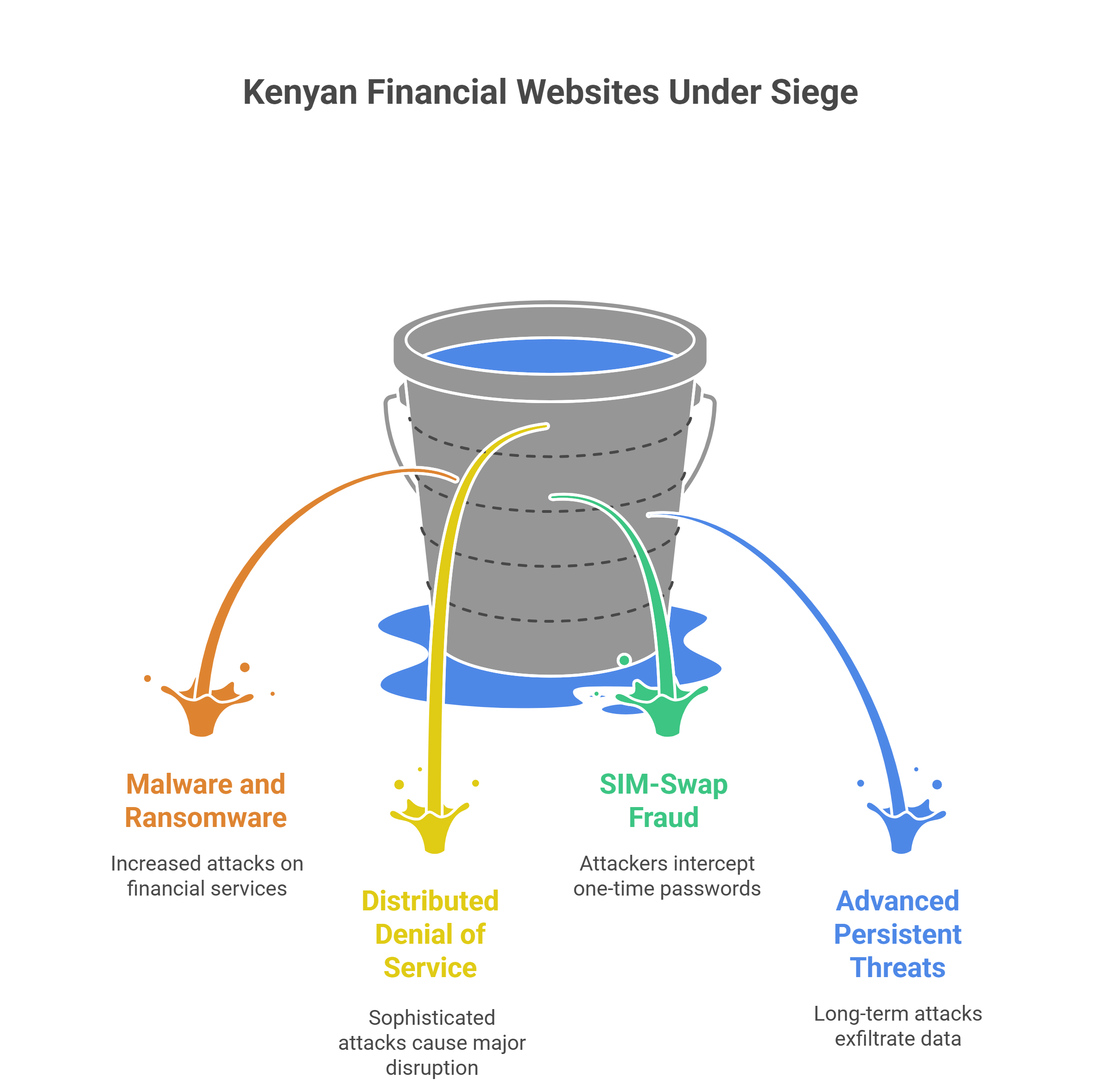
Understanding the threat landscape is essential for implementing appropriate security measures. Kenyan financial institutions face several distinct cybersecurity challenges:
Malware and Ransomware Attacks.
KE-CIRT/CC reported that malware attacks targeting financial services increased by 67% in 2023.
Of particular concern is the rise of banking trojans specifically designed to harvest credentials from Kenyan banking platforms.
Recent ransomware attacks have evolved beyond simple encryption to include data exfiltration, threatening to publish sensitive customer financial records unless ransoms are paid—a particularly devastating threat to financial institutions bound by confidentiality requirements.
Distributed Denial of Service (DDoS) Attacks
DDoS attacks targeting Kenyan financial websites have become more sophisticated, with attackers leveraging botnets to generate traffic exceeding 100 Gbps.
These attacks typically coincide with significant financial events such as IPOs or dividend payment periods to maximize disruption.
The Communications Authority of Kenya reported that financial institutions experienced an average of 3.4 DDoS attacks per quarter in 2023, with each attack lasting approximately 6-12 hours and costing an estimated KES 2.5 million in lost transactions and recovery efforts.
SIM-Swap Fraud and Mobile Banking Vulnerabilities
Unique to Kenya’s mobile-first financial ecosystem is the prevalence of SIM-swap fraud, where attackers gain control of a customer’s phone number to intercept one-time passwords.
These attacks often begin with compromised web applications that leak customer identifiers.
The Banking Fraud Investigation Department reported over 2,000 SIM-swap cases affecting Kenyan financial institutions in 2023, with an average loss of KES 180,000 per incident.
Advanced Persistent Threats (APTs)
International cybercriminal groups have increasingly targeted Kenyan financial infrastructure through APTs—long-term attacks that remain undetected for months while exfiltrating data.
These sophisticated threats often exploit zero-day vulnerabilities in web hosting environments before signature-based security tools can detect them.
According to cybersecurity firm Serianu, 72% of Kenyan financial institutions lack adequate detection mechanisms for these stealthy threats.
Essential Technical Security Measures.
SSL/TLS Encryption Implementation.
All Kenyan financial websites must implement HTTPS through SSL/TLS encryption. While free certificates from Let’s Encrypt provide basic encryption, financial institutions should consider EV (Extended Validation) certificates that provide visual trust indicators to customers.
The CBK guidelines specifically recommend a minimum of TLS 1.2 or higher with strong cipher suites that exclude vulnerable algorithms like RC4 and MD5.
Implementation best practices include:
- Enforcing HSTS (HTTP Strict Transport Security) headers to prevent downgrade attacks
- Configuring perfect forward secrecy to ensure past communications remain secure
- Setting appropriate certificate validity periods (maximum 1 year as per current CA/Browser Forum guidelines)
- Implementing certificate transparency monitoring to detect unauthorized certificates
Robust Server Hardening
Server hardening—securing the operating system and applications running on your hosting environment—is critical for Kenyan financial websites. This involves:
- Implementing kernel-level security modules like AppArmor or SELinux
- Disabling unnecessary services, ports, and protocols
- Regular security patching with minimal downtime windows (typically scheduled between 1-4 AM EAT)
- Implementing rigorous file integrity monitoring to detect unauthorized changes
- Configuring specific Apache/Nginx security directives to prevent common web attacks
Web Application Firewalls (WAF).
Financial websites must deploy specialized WAFs that understand financial transaction patterns and can detect anomalies. Modern WAFs offer Kenya-specific rule sets that understand local transaction patterns and can distinguish between legitimate traffic and attack attempts.
| WAF Feature | Tayo Host | HostAfrica | Truehost |
|---|---|---|---|
| OWASP Top 10 Protection | Complete | Partial | Partial |
| Kenya-Specific Rules | Yes | Limited | No |
| Machine Learning Detection | Advanced | Basic | None |
| Real-time Threat Intelligence | Yes | Yes | Limited |
Comprehensive Backup Strategies
Kenyan financial institutions must implement the 3-2-1 backup strategy: three copies of data on two different media types with one copy stored offsite.
For financial data, immutable backups are essential—these cannot be modified or deleted even by administrators, providing protection against insider threats and ransomware.
Best practices include:
- Automated daily backups with validation testing
- Quarterly disaster recovery drills to verify restoration capabilities
- Encryption of all backup data both in transit and at rest
- Geographically distributed storage with at least one copy outside the primary hosting region
Multi-Factor Authentication (MFA)
MFA implementation is mandatory for all administrative access to hosting environments for Kenyan financial websites.
The CBK guidelines specifically recommend hardware security keys for privileged users who can modify website content or access customer data.
Role-based access control should limit administrative privileges to those who absolutely require them, with just-in-time access provisioning for elevated permissions.
Compliance with Kenyan Regulations.
Data Protection Act 2019 Requirements.
The Data Protection Act establishes strict requirements for securing personally identifiable information (PII).
Financial websites must implement appropriate technical measures including pseudonymization and encryption of personal data.
The Act requires data controllers and processors to register with the Office of the Data Protection Commissioner and maintain detailed records of all processing activities.
Key compliance requirements for web hosting include:
- Data minimization: Collecting only necessary information
- Purpose limitation: Processing data only for specified purposes
- Storage limitation: Retaining data only as long as necessary
- Regular Data Protection Impact Assessments (DPIAs)
- Appointment of a Data Protection Officer for larger institutions
Central Bank of Kenya Cybersecurity Guidelines.
The CBK’s Guidance Note on Cybersecurity for Banking Institutions establishes specific technical requirements that apply to web hosting environments. These include:
- Mandatory vulnerability assessments and penetration testing by approved vendors every 6 months
- Comprehensive logging and monitoring of all hosting infrastructure
- 24-hour breach notification requirements
- Vendor risk management for hosting providers
- Annual technical compliance audits
Cross-Border Data Transfer Policies.
For Kenyan financial institutions using cloud hosting or international service providers, the Data Protection Act imposes restrictions on cross-border data transfers.
Financial data may only be transferred to countries with adequate data protection laws or where specific safeguards are in place.
This significantly impacts hosting decisions, as certain technical and legal measures must be implemented for international hosting arrangements.
Required safeguards include:
- Standard contractual clauses approved by the Data Commissioner
- Binding corporate rules for multinational financial groups
- Explicit consent from data subjects for international transfers
- Technical mechanisms to ensure data remains protected at international standards
Selecting a Secure Hosting Provider.
Essential Security Features.
When evaluating hosting providers for Kenyan financial websites, several critical security features must be present:
| Security Feature | Tayo Host | HostAfrica | Truehost | AWS |
|---|---|---|---|---|
| Kenya Data Residency | Yes | Yes | Partial | No |
| DDoS Protection | Advanced (40+ Tbps) | Basic (10 Tbps) | Limited (5 Tbps) | Advanced (Global) |
| Daily Backups | Automated (30 days) | Automated (7 days) | Manual | Self-managed |
| CBK Compliance Documentation | Comprehensive | Partial | Minimal | Generic |
| Incident Response SLA | 15 minutes | 1 hour | 4 hours | Varies by plan |
Case Study: Kenya Airways Credit Union Migration
The Kenya Airways SACCO, serving over 8,000 members, recently migrated its web infrastructure to Tayo Host from an international provider.
The migration was driven by three key factors: compliance with local data residency requirements, need for Kenya-specific security expertise, and cost optimization.
The results were significant:
- 69% reduction in security incidents within six months
- 43% improvement in page load times due to local hosting
- Full CBK compliance achieved without additional technical development
- 22% reduction in total cost of ownership compared to previous international hosting
Local vs. Global Provider Cost-Benefit Analysis
Kenyan financial institutions must weigh several factors when choosing between local and global hosting providers:
- Data Sovereignty: Local providers simplify compliance with Kenya’s data residency requirements, eliminating the need for complex cross-border transfer mechanisms.
- Latency: Local hosting typically reduces latency by 50-120ms compared to international providers, improving customer experience for transaction-heavy applications.
- Support Response: Local providers offer support aligned with Kenyan business hours and understand local regulatory requirements.
- Cost Structure: While international providers may offer lower base costs, compliance additions and data transfer fees often make local hosting more economical for financial services.
Incident Response & Disaster Recovery.
Mandatory Reporting Requirements0
Kenyan financial institutions must report security incidents to multiple authorities:
- Central Bank of Kenya: All cybersecurity incidents must be reported within 24 hours
- Communications Authority of Kenya: Major incidents affecting service availability
- Data Protection Commissioner: Any breach involving personal data within 72 hours
- KE-CIRT/CC: Voluntary reporting for coordinated response assistance
Effective reporting requires pre-established communication channels and templates that capture essential information while complying with disclosure requirements.
Disaster Recovery Planning.
Financial institutions must maintain documented disaster recovery plans specific to their web hosting environment. These plans should include:
- Recovery Time Objectives (RTOs) and Recovery Point Objectives (RPOs) aligned with CBK expectations (typically under 4 hours and 15 minutes respectively)
- Server failover strategies with automated health checks
- Geographic redundancy with at least one alternate processing site
- Regular testing through simulated disasters (minimum twice yearly)
- Specific procedures for different threat scenarios (ransomware, hardware failure, natural disasters)
Role of KE-CIRT/CC in Incident Support.
The Kenya Computer Incident Response Team Coordination Centre provides valuable resources during security incidents. Financial institutions should establish relationships with KE-CIRT/CC before incidents occur to enable:
- Access to threat intelligence specific to Kenyan financial sector attacks
- Coordination with other affected institutions during widespread incidents
- Technical assistance with complex threat mitigation
- Post-incident analysis and lessons learned
Conclusion.
Security for financial websites in Kenya requires a multi-layered approach that addresses both technical vulnerabilities and regulatory compliance.
The unique challenges facing Kenya’s financial sector—from mobile banking threats to specific regulatory requirements—demand tailored security measures beyond generic web hosting practices.
By implementing robust encryption, comprehensive backup strategies, proper server hardening, and selecting appropriate hosting providers with local expertise, Kenyan financial institutions can significantly reduce their risk exposure while maintaining customer trust and regulatory compliance.
As cyber threats continue to evolve, financial institutions must remain vigilant, regularly updating their security measures and disaster recovery capabilities.
The cost of implementing these measures is significant but pales in comparison to the potential financial and reputational damage of a successful attack.
By treating web hosting security as a strategic priority rather than a technical requirement, Kenyan financial institutions can protect their digital assets while enabling the continued growth of Kenya’s innovative financial ecosystem.
Don’t wait for a security incident to expose vulnerabilities in your web hosting environment.
Contact Tayo Host today for a comprehensive security assessment of your financial website infrastructure.
Our team of Kenya-based security experts understands both the technical challenges and regulatory requirements facing financial institutions.
We’ll help you implement a robust security framework that protects your data, ensures compliance, and maintains customer trust.