Leveraging Web Hosting for Kenyan Educational Institutions: Best Practices.

Kenyan educational institutions need reliable web hosting solutions to effectively deliver digital education in today’s connected world. The right hosting platform provides the foundation for school websites, e-learning portals, and educational resource management.
With Kenya’s growing digital education initiatives like DigiSchool, choosing appropriate hosting has become a critical decision for educational administrators nationwide.
This comprehensive guide explores how schools, colleges, and universities across Kenya can leverage web hosting to enhance their educational offerings, maintain compliance with local regulations, and provide seamless digital experiences for students and faculty alike.
Why Web Hosting Matters for Kenyan Educational Institutions.
Educational institutions in Kenya are increasingly relying on digital infrastructure to deliver learning content, manage administrative processes, and communicate with stakeholders. The foundation of this digital ecosystem is reliable web hosting.
The digital transformation of Kenya’s education sector, accelerated by initiatives like the Digital Literacy Programme, has created a pressing need for robust hosting solutions that can support various educational technologies.
According to recent surveys, 78% of Kenyan higher education institutions now offer some form of online learning, placing significant demands on their web infrastructure.
Poor hosting choices can lead to several challenges:
- Frequent downtime during critical periods (exam registration, course selection)
- Slow page loading speeds that frustrate students and staff
- Security vulnerabilities that expose sensitive institutional data
- Non-compliance with Kenya’s Data Protection Act (2019)
- Inadequate scalability during peak usage periods
For institutions operating with limited IT budgets, choosing cost-effective yet reliable hosting is crucial. The Kenya Education Network (KENET) reports that institutions spending at least 3% of their operational budget on web infrastructure show significantly better digital learning outcomes.
Key Features to Prioritize in Educational Web Hosting
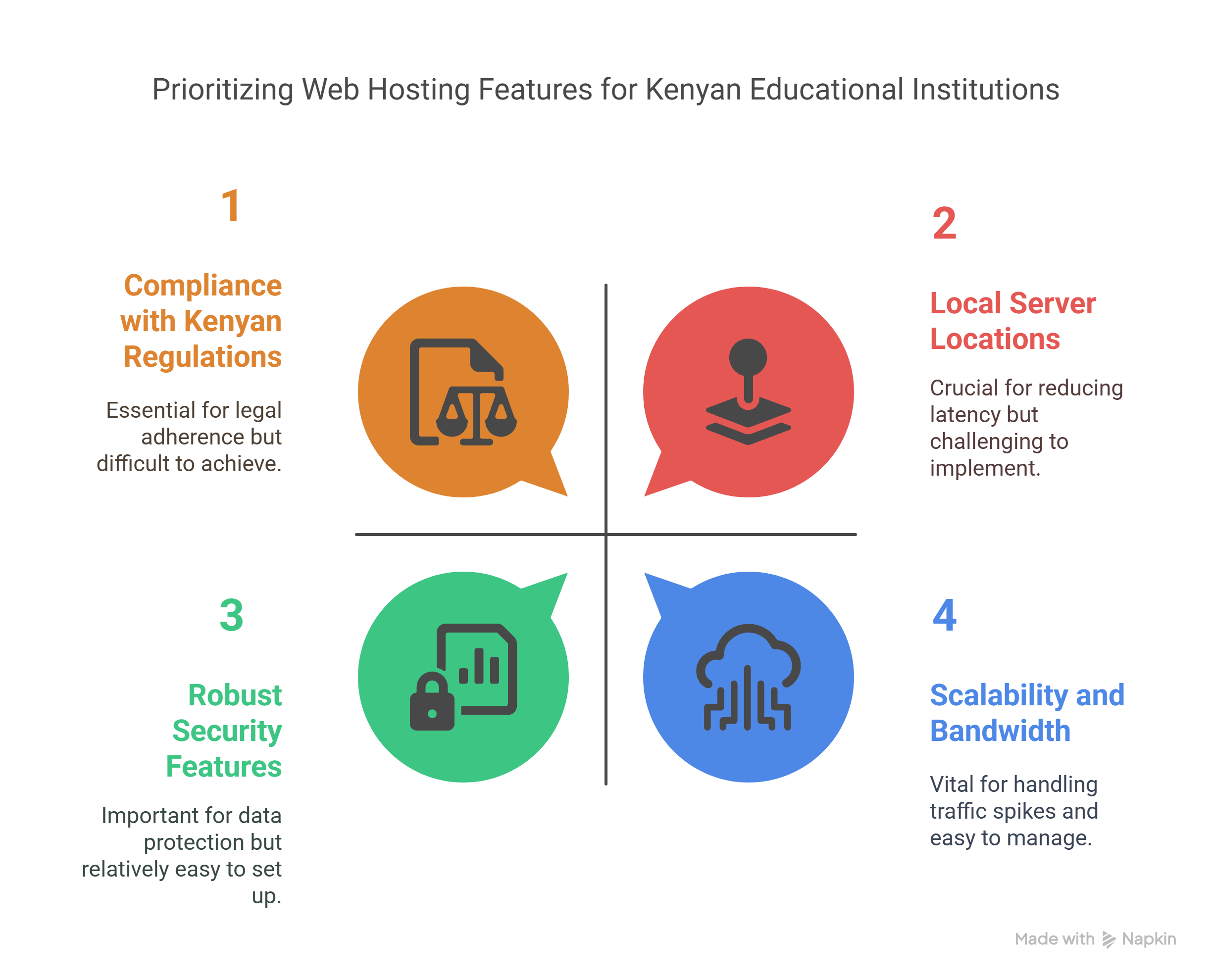
When selecting a web hosting provider for educational institutions in Kenya, administrators should prioritize these essential features:
1. Local Server Locations
Hosting on servers physically located in Kenya or East Africa significantly reduces latency, which is crucial for real-time applications like virtual classrooms. Tayo Host, with its data centers in Nairobi, offers page loading speeds up to 40% faster than international providers for local users.
2. Robust Security Features
Educational institutions store sensitive data including student records, financial information, and research data. Essential security features include:
- Free SSL certificates for encrypted connections
- Regular malware scanning and removal
- DDoS protection to prevent service disruptions
- Automated backup systems with local and cloud redundancy
3. Compliance with Kenyan Regulations
Kenya’s Data Protection Act (2019) requires specific data handling practices. Choose hosting providers that offer:
- Data localization options (keeping data within Kenyan borders)
- Clear data processing agreements
- User consent management tools
- Data portability and deletion capabilities
4. Scalability and Bandwidth
Educational websites experience predictable traffic spikes during registration periods, exam seasons, and when results are published. Ideal hosting should offer:
- Unlimited or generous bandwidth allowances
- Easy resource scaling (RAM, CPU) during peak periods
- Content Delivery Network (CDN) integration for distributing traffic loads
| Hosting Feature | Why It Matters for Educational Institutions | Recommended Providers in Kenya |
|---|---|---|
| 99.9%+ Uptime Guarantee | Ensures learning resources remain accessible 24/7 | Tayo Host, Sasahost, Kenya Web Experts |
| Local Data Centers | Faster load times for local users, regulatory compliance | Tayo Host, Angani Cloud, KIXP-connected providers |
| LMS Integration Support | Seamless operation with Moodle, Canvas, etc. | Tayo Host, HostAfrica, Truehost Cloud |
| M-Pesa Payment Integration | Simplified fee collection and payment processing | Tayo Host, Sasahost, Hostpinnacle |
Case Study: Tayo Host’s Partnership with Kenyan Universities
Tayo Host has emerged as a leading provider of web hosting services for Kenyan educational institutions, with several successful implementations showcasing best practices:
Case Study: Technical University of Mombasa
When TUM needed to upgrade its e-learning platform to support 20,000+ concurrent users, they migrated to Tayo Host’s cloud infrastructure. The results were significant:
- Page loading times decreased by 63% for on-campus users
- System uptime improved from 96.2% to 99.97%
- Student satisfaction with the e-learning platform increased by 41%
- IT support tickets related to system performance decreased by 78%
The implementation included custom configurations for Moodle hosting, dedicated database servers, and integration with the university’s authentication systems.
Author Note: Tayo Host’s collaboration with educational institutions extends beyond basic hosting services to include technical training for IT staff, specialized backup solutions for academic data, and custom development for educational applications.
Optimizing Educational Websites for Search Engines
For educational institutions, search visibility is crucial for attracting prospective students, sharing research, and establishing institutional authority. Effective SEO strategies include:
Location-Specific Optimization
Educational institutions should leverage their location in Kenya for improved local search visibility:
- Include location keywords in meta titles (e.g., “Computer Science Degrees in Nairobi”)
- Create location-specific landing pages for multiple campuses
- Ensure NAP (Name, Address, Phone) consistency across all web properties
- Register with Google My Business and ensure accurate information
Educational Content Optimization
Course descriptions, faculty profiles, and research publications should be optimized for relevant keywords:
| Website Section | SEO Optimization Strategy | Example Implementation |
|---|---|---|
| Course Pages | Include program-specific keywords, certification details | “Accredited Nursing Diploma in Kisumu” vs generic “Nursing Program” |
| Faculty Profiles | Highlight specializations, research areas | Include “Expert in Kenyan Agricultural Economics” in title tags |
| Research Publications | Use schema markup for academic papers | Implement ScholarlyArticle schema for better Google Scholar indexing |
| Events Calendar | Structured data for events | Use Event schema markup with location coordinates for local search |
Mobile Optimization
With 87% of Kenyan internet users accessing content via mobile devices, educational websites must prioritize mobile performance:
- Implement responsive design that adapts to various screen sizes
- Minimize image file sizes without sacrificing quality
- Enable caching to improve load times on slower connections
- Implement AMP (Accelerated Mobile Pages) for critical content
Addressing Connectivity Challenges in Rural Educational Institutions
Many Kenyan educational institutions operate in areas with limited connectivity, requiring specialized hosting solutions:
Offline-First Applications
Rural schools can benefit from hosting solutions that support progressive web applications (PWAs) with offline capabilities. These applications:
- Cache essential learning content for offline access
- Synchronize data when connectivity is available
- Function with minimal bandwidth requirements
Edge Hosting Solutions
Edge computing brings hosting resources closer to users, particularly beneficial for institutions in remote areas:
- Content distributed across multiple small-scale servers
- Reduced dependence on central data centers
- Lower latency for users in rural locations
Tayo Host offers specialized edge hosting solutions that have been successfully implemented in schools participating in the DigiSchool program, showing a 57% improvement in content delivery reliability compared to traditional hosting models.
Future Trends: 5G and Cloud Hosting for Kenyan Education
The educational hosting landscape in Kenya is evolving rapidly with several emerging trends:
5G Integration
The rollout of 5G infrastructure in Kenya promises to transform educational content delivery:
- Ultra-low latency enabling real-time virtual laboratories
- Enhanced capacity for video-intensive learning
- IoT integration for smart campuses
Tayo Host is already developing 5G-optimized hosting solutions that enable bandwidth-intensive applications like virtual reality classrooms and remote laboratory access.
Containerized Hosting for Educational Applications
Modern educational platforms benefit from containerization technologies:
- Isolated environments for different applications (LMS, SIS, etc.)
- Improved resource allocation during usage spikes
- Simplified migration between hosting providers
According to projections from the Kenya ICT Authority, over 65% of higher education institutions will adopt containerized hosting by 2025, driving further need for specialized educational hosting solutions.
Final Thoughts: Selecting the Right Hosting Partner.
Choosing the right web hosting solution is a critical decision for Kenyan educational institutions looking to enhance their digital offerings. The ideal hosting partner should provide not just technical infrastructure, but also understand the unique challenges and requirements of the education sector.
By prioritizing local server presence, robust security, compliance with Kenyan regulations, and scalability, institutions can establish a solid foundation for their digital educational offerings. Additionally, implementing proper SEO strategies ensures that these educational resources reach their intended audiences effectively.
As Kenya continues its educational digital transformation, partnerships with forward-thinking hosting providers like Tayo Host will be essential in creating resilient, accessible, and effective digital learning environments that serve students across the nation.
Take Your Educational Institution’s Online Presence to the Next Level.
Ready to enhance your educational institution’s digital infrastructure? Evaluate your current hosting solution against the best practices outlined in this guide.
For personalized assistance, connect with Tayo Host’s education specialists who understand the unique requirements of Kenyan schools, colleges, and universities.
Their dedicated educational hosting packages include specialized support for learning management systems, student information systems, and research applications—providing the foundation your institution needs for digital success.