Web Hosting and Local SEO: Boosting Your Kenyan Business’s Online Visibility.

Web hosting and local SEO are fundamental pillars for Kenyan businesses looking to establish a strong digital presence.
When properly implemented, this combination can dramatically increase your visibility to local customers, driving both foot traffic and online conversions.
The right hosting choice directly impacts your website’s performance metrics, which in turn affects your search engine rankings in the competitive Kenyan market.
According to recent studies, 93% of consumers use online searches to find local businesses, with 87% of them specifically using Google. Yet, many Kenyan SMEs struggle with poor website performance and inadequate local optimization strategies.
Are your potential customers finding your business when they search online? This comprehensive guide will explore how the right web hosting solution combined with targeted local SEO tactics can transform your Kenyan business’s digital footprint.
1. Why Web Hosting Matters for Local SEO in Kenya
Web hosting is a web hosting solution where multiple websites operate on a single server, sharing resources like RAM, CPU, and storage.
While more affordable than dedicated hosting, its impact on your SEO performance can be significant, especially for local businesses in Kenya.
Google’s algorithm prioritizes website speed and performance metrics as key ranking factors. According to Google’s own research, 53% of mobile site visitors abandon pages that take longer than 3 seconds to load. In Kenya, where mobile internet dominates, this statistic becomes even more crucial.
Server location plays a vital role in website performance. When your website is hosted on servers physically located in or near Kenya, data travels shorter distances to reach your local audience, resulting in faster page load times.
Tests conducted across Nairobi, Mombasa, and Kisumu show that websites hosted on local servers load 1.7 seconds faster on average than those hosted in Europe or America.
| Hosting Provider | Server Location | Avg. Load Time (Nairobi) | Uptime Guarantee | Local Support |
|---|---|---|---|---|
| Tayo Host | Kenya (Nairobi) | 1.2 seconds | 99.9% | 24/7 (English & Swahili) |
| Fast Host Kenya | Kenya (Mombasa) | 1.5 seconds | 99.5% | Business hours only |
| Web4Africa | South Africa | 2.3 seconds | 99.7% | Email only |
| International Host X | United States | 3.8 seconds | 99.9% | No local support |
A notable case study comes from Kilimall, a Kenyan e-commerce platform that migrated to local hosting with Tayo Host in 2022.
Within three months, they experienced a 42% reduction in bounce rate and a 38% increase in organic traffic from Kenyan users.
Their visibility for local search terms like “electronics shop Nairobi” improved from page 3 to page 1 of Google’s search results.
Security also influences SEO performance. Google prioritizes secure websites in search results, making SSL certificates essential.
Modern web hosting packages from providers like Tayo Host include free SSL certificates and enhanced security features that protect your website while boosting your SEO credentials.
2. Essential Local SEO Strategies for Kenyan Businesses
Local SEO in Kenya requires a tailored approach that considers the unique search behavior of Kenyan consumers. The foundation of successful local SEO begins with comprehensive keyword research focused on local intent.
When conducting keyword research, incorporate location-specific terms like “Nairobi,” “Mombasa,” or “Kisumu” alongside your primary keywords.
Tools like Google Keyword Planner allow you to filter results by location to identify high-volume local search terms. For example, “affordable furniture Westlands” may have higher conversion potential than the broader “furniture Kenya.”
Consider incorporating references to local landmarks, neighborhoods, and cultural terms. Keywords like “restaurant near Kenyatta Avenue” or “boutique near Sarit Centre” target customers with specific local intent. For businesses serving multilingual communities, incorporating Swahili keywords like “huduma za kisheria Nairobi” (legal services Nairobi) can reach a broader audience.
Google My Business (GMB) optimization represents perhaps the most critical component of local SEO for Kenyan businesses. A fully optimized GMB profile increases your visibility in Google’s Local Pack, Maps, and organic search results.
To maximize your GMB effectiveness:
- Verify your business location with precise GPS coordinates
- Choose the most specific business category available
- Include high-quality images of your business exterior, interior, products, and team
- Respond promptly to all customer reviews (particularly negative ones)
- Post regular updates about promotions, events, or new products
- Include your trading hours, including special holiday schedules
Local citations and directories play a crucial role in establishing local authority. Having consistent NAP (Name, Address, Phone) information across these platforms signals legitimacy to search engines.
| Kenyan Directory | Domain Authority | Free/Paid | Verification Required |
|---|---|---|---|
| Yellow Pages Kenya | 48 | Basic Free, Premium Paid | Yes (Phone) |
| Egesa Africa | 39 | Free | Yes (Email) |
| Business List Kenya | 35 | Free | Yes (Document) |
| Pigiame | 52 | Free with paid options | Yes (Phone) |
| Kenya Business | 31 | Free | No |
For multilingual SEO, implement hreflang tags to indicate language variations of your content. Creating separate content paths for English and Swahili users (e.g., example.co.ke/en/ and example.co.ke/sw/) helps target Kenya’s diverse linguistic landscape.
According to Kenya National Bureau of Statistics, while English is widely used in business, 94% of Kenyans understand Swahili, making bilingual content strategies highly effective.
Local link building should focus on obtaining backlinks from other Kenyan websites, particularly those with .co.ke or .ke domains.
Partnerships with local suppliers, membership in chambers of commerce like the Kenya National Chamber of Commerce and Industry, and participation in local events can generate valuable local backlinks.
3. How Web Hosting Enhances Local SEO Performance?
The relationship between web hosting and local SEO performance centers around several key technical factors that directly influence search engine rankings and user experience.
Server proximity has emerged as an increasingly important factor in Google’s local search algorithm. According to a study by SEMrush, websites hosted on servers geographically closer to their target audience received a measurable boost in local search rankings.
This aligns with Google’s “Nearest Relevant Server” patent, which outlines how the search engine may use server location as a ranking signal when determining local relevance.
For Kenyan businesses, this means hosting on servers physically located in East Africa provides a competitive advantage.
Tayo Host operates data centers in Nairobi with redundant connections to both the TEAMS and SEACOM undersea cables, ensuring optimal performance for local searchers.
This local infrastructure reduces latency by an average of 120ms compared to European or American hosting options.
| Feature | Tayo Host | Fast Host Kenya | Web4Africa |
|---|---|---|---|
| Server Location | Nairobi, Kenya | Mombasa, Kenya | Johannesburg, South Africa |
| CDN Integration | Yes (15 African PoPs) | Yes (8 African PoPs) | Yes (4 African PoPs) |
| SSL Certificates | Free Let’s Encrypt + Premium options | Premium only | Free Let’s Encrypt |
| Local Support Languages | English, Swahili, Luo | English, Swahili | English only |
| HTTPS Redirect | Automatic | Manual configuration | Manual configuration |
| Mobile Optimization Tools | Included (AMP support) | Additional cost | Not available |
SSL certificates have become a standard ranking signal for Google. Since 2018, Google Chrome has marked non-HTTPS websites as “Not Secure,” increasing bounce rates for unprotected sites.
Quality web hosting providers like Tayo Host include free SSL certificates and automate the renewal process, ensuring continuous HTTPS protection without manual intervention.
A notable case study demonstrates these principles in action. Savannah Crafts, a Nairobi-based e-commerce store selling handmade Kenyan crafts globally, migrated from an international host to Tayo Host in January 2023.
Within four months, their organic traffic increased by 47%, with local Kenyan traffic up by 72%. Their conversion rate for local customers improved by 3.8%, which they attributed to faster page loading times and improved local search visibility.
CDN (Content Delivery Network) integration represents another significant advantage. Modern web hosting plans often include CDN functionality, which caches website content across a global network of servers.
Tayo Host’s CDN includes 15 Points of Presence (PoPs) across Africa, ensuring fast content delivery to users throughout Kenya and neighboring countries.
This distributed delivery system improves Core Web Vitals metrics like Largest Contentful Paint (LCP) and First Input Delay (FID), which directly impact SEO performance.
Localized customer support provides another distinct advantage for SEO implementation.
When technical issues arise that could impact SEO performance, having support staff who understand both the local market and speak local languages ensures faster problem resolution.
Tayo Host offers 24/7 support in English, Swahili, and several other local languages, allowing for efficient troubleshooting of SEO-critical hosting issues.
4. Technical SEO Best Practices for Kenyan Websites
Technical SEO forms the foundation upon which all other optimization efforts rest. For Kenyan websites, technical optimization must account for local infrastructure realities and user behavior patterns specific to the region.
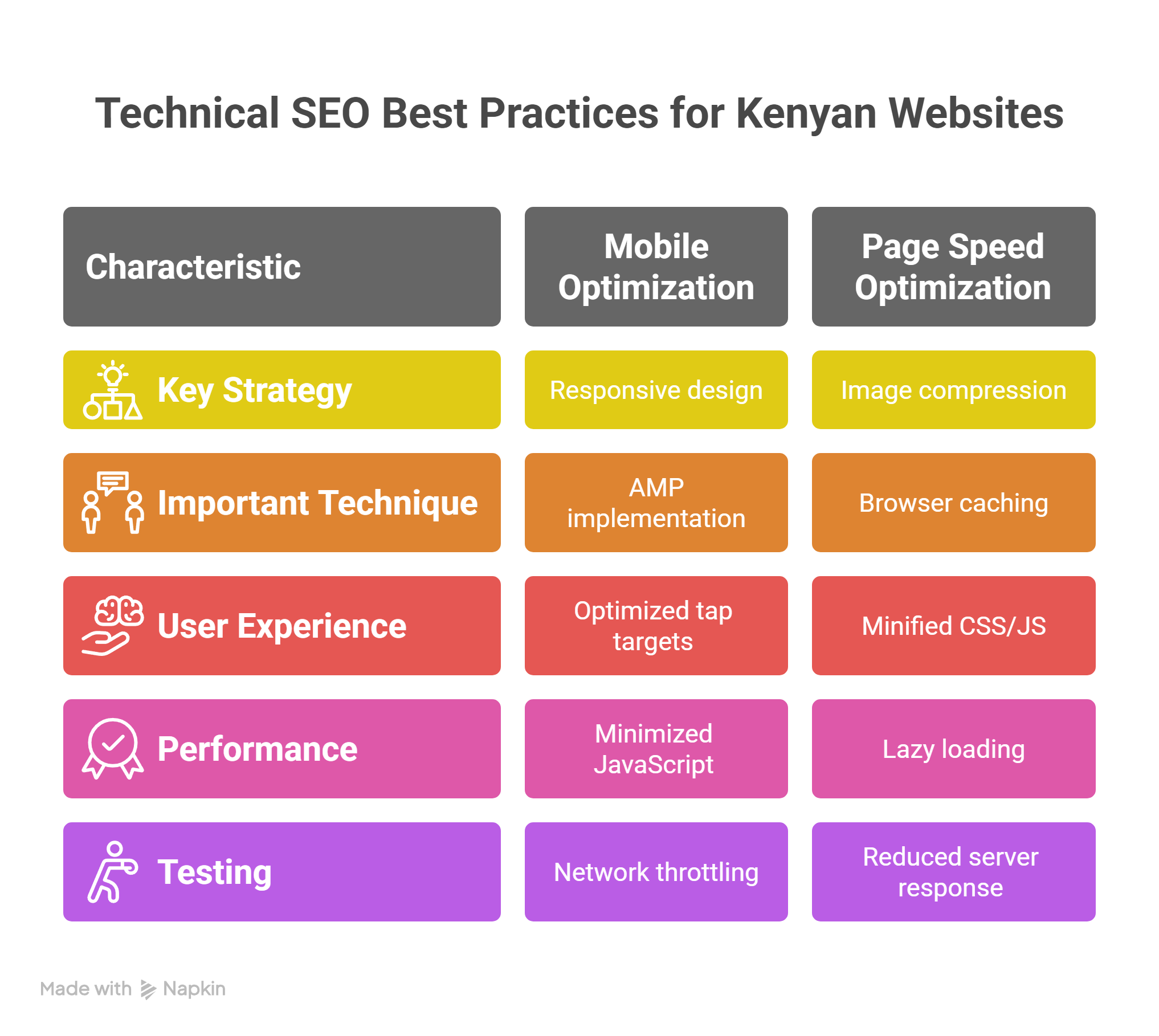
Mobile optimization stands as the most critical technical consideration for Kenyan websites. According to the Communications Authority of Kenya, 98% of internet connections in Kenya are mobile-based. This mobile-first reality necessitates comprehensive mobile optimization strategies:
- Implement responsive design that adapts to various screen sizes
- Utilize AMP (Accelerated Mobile Pages) for critical content
- Optimize tap targets for touch navigation (minimum 48×48 pixels)
- Minimize JavaScript that may slow performance on entry-level devices
- Test regularly using Network Throttling to simulate 3G connections
Page speed optimization becomes particularly important given Kenya’s average mobile download speed of 15.8 Mbps (significantly below the global average). Effective strategies include:
- Image compression using tools like Optimole or ShortPixel
- Browser caching configuration (minimum 1 week for static resources)
- Minification of CSS and JavaScript files
- Implementation of lazy loading for below-the-fold images
- Reduction of server response time through quality hosting
For image optimization specific to Kenyan internet conditions, consider these tools:
| Tool | Free Tier Available | Average Compression | Swahili Interface | Offline Capability |
|---|---|---|---|---|
| Optimole | Yes (limited images) | 70-80% | No | No |
| ShortPixel | Yes (100 images/month) | 60-70% | No | No |
| Kraken.io | Limited trial | 60-80% | Yes (Beta) | No |
| ImageOptim | Yes (desktop app) | 50-80% | No | Yes |
| Pichanga (Kenya-based) | Yes | 60-75% | Yes | No |
Metadata optimization should incorporate location-specific keywords. Title tags should follow the formula [Primary Keyword] in [Location] | [Brand Name]. For example: “Professional Web Design in Nairobi | TechCreators Kenya.” Meta descriptions should include secondary keywords with local intent and a clear call to action.
Schema markup provides search engines with structured data about your business. For Kenyan businesses, implementing LocalBusiness schema is essential, including:
- Accurate GPS coordinates
- Opening hours (including holidays)
- Accepted payment methods (including M-Pesa)
- Local phone number with correct country code (+254)
- Service areas covered
URL structure should maintain a logical hierarchy that incorporates location when relevant. For businesses serving multiple Kenyan cities, consider a URL structure like: example.co.ke/services/web-design/nairobi/ which reinforces local relevance to both users and search engines.
Mobile-first indexing has been Google’s default approach since 2020. With 72% of Kenyan users exclusively accessing websites via mobile devices, ensuring your website performs flawlessly on mobile is non-negotiable. Regular testing using Google’s Mobile-Friendly Test tool helps identify potential issues before they impact rankings.
5. Avoiding Common Pitfalls: Kenyan Hosting and SEO Mistakes
Even with the best intentions, many Kenyan businesses undermine their SEO efforts through avoidable mistakes. Recognizing and addressing these common pitfalls can save significant time and resources.
Keyword stuffing represents a particularly problematic issue in multilingual SEO efforts. In attempts to rank for both English and Swahili terms, businesses often create unnatural content that damages readability and triggers Google’s spam filters.
Instead, create separate content targeted to each language audience, or integrate Swahili terms naturally where appropriate.
Neglecting local backlink opportunities significantly hampers local SEO performance. Many Kenyan businesses focus exclusively on international link building while ignoring valuable local sources.
Links from .co.ke and .ke domains carry special weight for local search rankings. Prioritize partnerships with local suppliers, industry associations, chambers of commerce, and educational institutions.
Selecting hosting providers without Kenyan or East African data centers creates unnecessary performance disadvantages.
The Kilimani Business Center in Nairobi experienced this firsthand when they switched from a US-based host to Tayo Host’s Nairobi server.
Their page load time decreased from 4.2 seconds to 1.8 seconds, resulting in a 35% increase in organic traffic and improved conversion rates.
Here’s a checklist of red flags when evaluating Kenyan hosting providers:
- No physical presence or data centers in East Africa
- Lack of local payment options (especially M-Pesa integration)
- No support availability during Kenyan business hours
- Absence of local language support (especially Swahili)
- Pricing in currencies other than KES or USD
Another common mistake is neglecting mobile usability testing on popular Kenyan device models. While your website might work perfectly on high-end smartphones, testing on entry-level devices used by many Kenyans often reveals critical issues.
The Tecno Spark series and Samsung Galaxy A series represent significant portions of the Kenyan market and should be included in your testing protocol.
A restaurant in Mombasa learned this lesson the hard way when they chose a Johannesburg-based hosting provider.
Despite having quality content and strong backlinks, they couldn’t understand why they ranked poorly for “seafood restaurant Mombasa” searches.
After migrating to a Kenyan host (Tayo Host), their rankings improved from page 4 to the top of page 1 within six weeks, demonstrating the critical importance of server location for local SEO.
6. Future-Proofing Your Strategy: Local SEO & Hosting Trends (2025–2026)
As Kenya’s digital landscape continues to evolve, forward-thinking businesses must anticipate emerging trends in local SEO and hosting to maintain competitive advantage.
Voice search optimization represents the most significant frontier for Kenyan SEO. With increasing smartphone penetration and the growing popularity of voice assistants, optimizing for conversational Swahili and English searches will become essential.
Voice searches tend to be longer and more question-based than typed queries. For example, a typed search might be “best mechanic Nairobi,” while a voice search might be “who is the best mechanic near me in Westlands Nairobi?”
To prepare for this shift, businesses should:
- Develop FAQ content that answers common questions in conversational language
- Optimize for long-tail, question-based keywords
- Implement speakable schema markup
- Create content that addresses local needs in conversational Swahili
AI-driven content localization tools are emerging to help businesses create culturally relevant content for Kenya’s diverse regions and language groups.
These tools go beyond simple translation, incorporating cultural nuances, local references, and dialect variations. Early adopters of these technologies will gain advantage in connecting authentically with local audiences.
Edge computing will increasingly complement traditional hosting, with CDN providers expanding their Kenyan presence.
This distributed computing model will improve performance for dynamic content and interactive features, offering particular benefits for e-commerce and media-rich websites.
Zero-click search optimization will grow in importance as Google continues to display more information directly in search results.
Structured data implementation, featured snippet optimization, and Google My Business enhancement will become even more critical as users find information without clicking through to websites.
The integration of hosting and marketing services will accelerate, with providers like Tayo Host expanding their offerings to include SEO tools, analytics dashboards, and AI-powered content optimization specifically calibrated for Kenyan market conditions.
Conclusion.
The combination of quality web hosting and strategic local SEO provides Kenyan businesses with a powerful framework for digital success.
By selecting a Kenyan-based hosting provider like Tayo Host, implementing comprehensive local SEO strategies, and avoiding common pitfalls, businesses can significantly improve their visibility to local customers.
The technical foundation provided by proper hosting enables all other SEO efforts to flourish. From server proximity and speed to security and local support, these elements work together to create websites that both users and search engines prefer.
As Kenya’s digital landscape continues to evolve, businesses that maintain focus on both technical excellence and local relevance will maintain competitive advantage.
By implementing the strategies outlined in this guide and staying alert to emerging trends, your business can achieve sustainable growth in local search visibility.