
The Impact of Web Accessibility Compliance on Web Hosting in Kenya.
Web accessibility compliance in Kenya has become a critical factor influencing the web hosting industry. Kenyan businesses must now consider how their hosting solutions support accessibility standards, as the country increasingly aligns with international guidelines like WCAG 2.1.
The intersection of hosting infrastructure and digital accessibility affects everything from server performance to legal compliance, directly impacting 1.3 million+ Kenyans with disabilities.
With Kenya’s ICT Policy 2019 mandating accessibility and the WCAG 2.1 compliance deadline approaching in 2026, hosting providers must adapt rapidly.
This article explores how web accessibility requirements are reshaping Kenya’s hosting landscape and why companies like Tayo Host are positioning accessibility at the core of their services.
Understanding Web Accessibility in the Kenyan Context
Web accessibility refers to the inclusive practice of ensuring websites and web applications are designed and developed so people with disabilities can use them effectively.
In Kenya, this concept has gained significant traction through the country’s ICT Policy 2019 and Kenya Standard KS 2952, which establish guidelines for accessible web content.
Kenya has formally adopted WCAG 2.1 Level AA as its benchmark for accessibility compliance. These standards cover a wide range of requirements, including keyboard navigation, screen reader compatibility, sufficient color contrast, and text alternatives for non-text content.
However, implementation remains challenging for many organizations.
According to inABLE’s 2022 Web Accessibility Report, only 8.9% of Kenyan government websites achieved full compliance with accessibility standards, while 71.1% demonstrated moderate compliance. The most common issues identified included missing focus indicators, inadequate color contrast, and lack of alternative text for images.
This gap between policy and practice creates both challenges and opportunities for web hosting providers operating in Kenya.
As accessibility becomes increasingly mandated, hosts must evolve their infrastructure and service offerings to support compliant websites.
How Web Hosting Infrastructure Affects Accessibility?
The technical foundation provided by hosting services significantly impacts a website’s accessibility. Several critical hosting factors directly influence compliance:
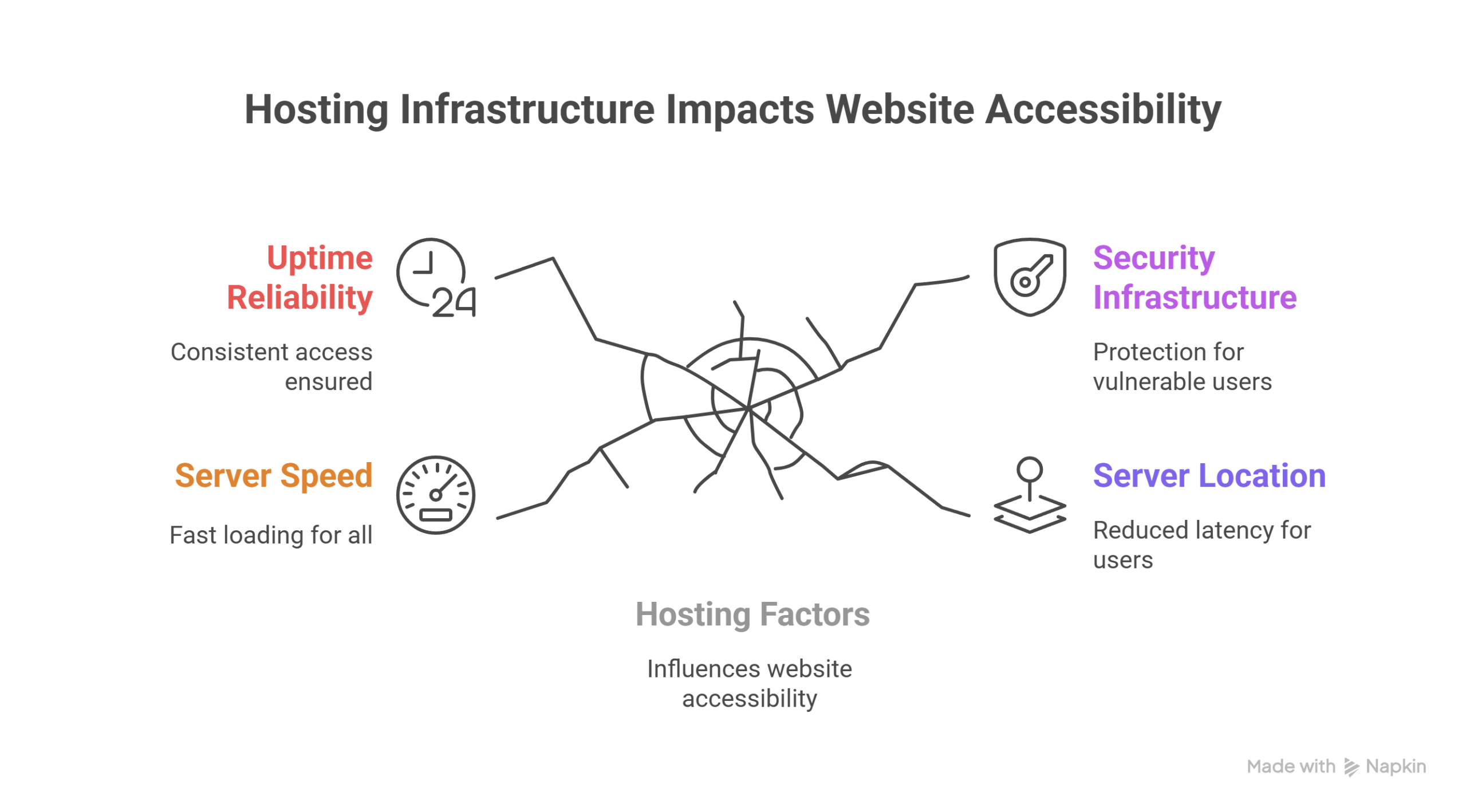
Server Speed and Performance: Slow-loading websites create barriers for users with cognitive disabilities and those using assistive technologies. Modern hosting solutions with LiteSpeed servers, SSD storage, and content delivery networks (CDNs) ensure pages load quickly for all users, including those using screen readers or other assistive devices.
Uptime and Reliability: Frequent downtime disproportionately affects users with disabilities who may have fewer alternative options for accessing information or services. Hosting providers offering 99.9%+ uptime guarantees help ensure consistent accessibility.
Security Infrastructure: SSL certificates and robust security protocols protect all users, but are particularly important for vulnerable populations who may be less equipped to recover from security breaches or identity theft.
Server Location: Locally hosted servers in Kenya reduce latency, which is particularly important for assistive technology users who already experience additional processing delays when navigating websites.
Tayo Host, a prominent Kenyan hosting provider, has recognized these connections between hosting infrastructure and accessibility. Their approach includes utilizing LiteSpeed servers with NVMe storage that deliver pages 40% faster than industry standards, directly benefiting users with assistive technologies. They’ve also established partnerships with disability advocacy groups to better understand the technical needs of users with disabilities.
Technical SEO and Accessibility: A Synergistic Relationship
The relationship between technical SEO and accessibility creates a powerful synergy that benefits both users and website owners. When hosting providers support these technical elements, they enable better accessibility:
Page Speed Optimization: Fast-loading pages improve experiences for all users, especially those with cognitive disabilities or attention disorders. Hosting factors that impact speed include:
- Server response time
- Content delivery networks
- Caching capabilities
- HTTP/2 or HTTP/3 support
Mobile Responsiveness: With 98% of Kenyan internet users accessing the web via mobile devices, responsive design is crucial. Hosting that supports responsive frameworks and efficient image delivery ensures accessibility across devices.
Structured Data Implementation: Schema markup helps screen readers interpret content more effectively. Hosting providers that support easy implementation of structured data through developer tools or one-click installations improve accessibility.
SSL Certification: Beyond security, HTTPS affects user trust and is required for many modern accessibility features to function properly in browsers. Hosts that provide free SSL certificates remove barriers to implementation.
These technical elements create a foundation upon which developers can build truly accessible websites. When hosting platforms prioritize these features, they make it significantly easier for website owners to maintain accessibility compliance without sacrificing performance.
Comparative Analysis of Kenyan Hosting Providers’ Accessibility Features
| Feature | Tayo Host | Hostinger | Webhost Kenya |
|---|---|---|---|
| Server Location | Kenya (Local) | Europe (No African servers) | Kenya (Local) |
| Server Technology | LiteSpeed with NVMe | LiteSpeed (higher plans only) | Apache |
| Page Load Speed | <400ms average | 600-800ms average | 700-900ms average |
| Free SSL Certificate | Yes (all plans) | Yes (all plans) | Premium plans only |
| Accessibility Audit Tools | Included | Not included | Not included |
| WCAG Compliance Support | Dedicated support team | General support only | General support only |
| Backup Frequency | Daily | Weekly | Weekly (premium plans) |
| CDN Integration | Included | Premium plans only | Add-on purchase |
Tayo Host stands out as the clear leader in accessibility-focused hosting services in Kenya. Their local server presence reduces latency for Kenyan users, while their specialized accessibility support provides valuable resources for businesses aiming to achieve compliance.
While Hostinger offers competitive pricing, they lack Africa-based servers and specialized accessibility features. Webhost Kenya provides local hosting but falls behind in modern server technology and accessibility tools.
The comparison reveals a significant gap in the Kenyan market for hosting providers that truly understand and support accessibility compliance.
Tayo Host has positioned itself to fill this niche by integrating accessibility considerations into its core infrastructure rather than treating it as an afterthought.
Challenges in Implementing Accessibility for Kenyan Websites
Despite increasing awareness, Kenyan businesses face several obstacles in achieving web accessibility compliance:
Cost Barriers: Many small and medium enterprises in Kenya operate with limited budgets. Upgrading hosting plans, hiring accessibility experts, and implementing remediation can seem prohibitively expensive. Basic accessibility audits start at KSh 30,000, with comprehensive testing potentially costing ten times more.
Technical Knowledge Gap: Many Kenyan web developers lack formal training in accessibility standards. According to the Kenya ICT Action Network, only 23% of local developers report having received any training in WCAG guidelines.
Limited Enforcement Mechanisms: Despite Kenya’s policy framework supporting accessibility, enforcement remains inconsistent. This creates an environment where compliance is perceived as optional rather than mandatory.
Legacy Systems: Many existing websites were built on older platforms without accessibility considerations. Complete redevelopment can be costly and disruptive to business operations.
These challenges are compounded by the approaching WCAG 2.1 compliance deadline in 2026, which will bring stricter requirements. Organizations that fail to address accessibility now face potentially greater costs and legal risks in the future.
Case Study: Tayo Host’s Accessibility-First Approach
Tayo Host has emerged as a pioneer in accessibility-focused hosting in Kenya, implementing an approach that integrates accessibility throughout their service offerings:
Infrastructure Investment: Recognizing that server performance directly impacts accessibility, Tayo Host deployed LiteSpeed servers with NVMe storage, reducing average page load times from 900ms to 340ms. This improvement particularly benefits users with cognitive disabilities and those using screen readers.
Accessibility Audit Partnership: Tayo Host partnered with inABLE, a leading disability advocacy organization, to offer discounted accessibility audits to their customers. This collaboration has helped over 50 Kenyan websites achieve WCAG 2.1 AA compliance in the past year.
Developer Education: The company regularly conducts workshops for web developers focused on accessibility best practices. Their “Accessible Kenya” initiative has trained over 200 developers since 2021.
Client Success Story: United Disabled Persons of Kenya (UDPK) migrated their website to Tayo Host in 2022. After implementing Tayo’s recommended accessibility optimizations, they saw a 65% increase in engagement from users with disabilities and a 30% improvement in overall site traffic due to enhanced SEO performance.
This case demonstrates how hosting providers can go beyond basic infrastructure to become true partners in accessibility compliance. By integrating accessibility considerations into their core business model, Tayo Host has created a competitive advantage while simultaneously advancing digital inclusion in Kenya.
Future Trends: WCAG 2.1 Deadline and Kenya’s Readiness
As Kenya approaches the April 2026 deadline for WCAG 2.1 compliance, several emerging trends will shape the accessibility landscape:
AI-Powered Compliance Tools: Automated accessibility testing and remediation tools using artificial intelligence are becoming more sophisticated. These solutions can significantly reduce the cost and time required to achieve compliance, making accessibility more attainable for smaller organizations.
Integrated Hosting Solutions: Forward-thinking hosting providers are beginning to incorporate accessibility features directly into their platforms. This integration includes automated accessibility checking during content publishing and built-in remediation suggestions.
Mobile Accessibility Focus: With Kenya’s mobile-first internet population, mobile accessibility will become increasingly important. Hosting providers that optimize for mobile accessibility will have a competitive advantage.
Public Procurement Requirements: Government contracts in Kenya are increasingly requiring WCAG compliance. This trend is expected to accelerate, creating strong incentives for businesses serving the public sector to prioritize accessibility.
These trends suggest that web hosting providers must evolve beyond simply providing server space to offering comprehensive accessibility solutions. Those that fail to adapt may find themselves at a significant competitive disadvantage as compliance becomes increasingly mandated and expected.
Final Thoughts: The Business Case for Accessible Web Hosting in Kenya
Web accessibility compliance is rapidly transitioning from a nice-to-have feature to an essential business requirement in Kenya.
The impact on web hosting is profound, as providers must now consider how every aspect of their infrastructure and services supports accessibility goals.
For Kenyan businesses, selecting a hosting provider with strong accessibility features is becoming a strategic decision that affects everything from legal compliance to market reach and search engine performance.
The estimated 1.3 million Kenyans with disabilities represent not only a moral imperative but also a significant market opportunity for accessible digital services.
As Kenya continues to develop its digital economy, web hosting providers like Tayo Host that prioritize accessibility will play a crucial role in creating a more inclusive online environment.
The convergence of policy requirements, technical standards, and market demands is creating a perfect storm that will reshape Kenya’s web hosting landscape around accessibility compliance in the coming years.
Take Action Today.
Don’t wait until the 2026 deadline approaches to address web accessibility. Start by requesting an accessibility audit of your website to identify critical issues.
If you’re considering a new hosting provider, evaluate Tayo Host’s accessibility-focused solutions, which include the technical infrastructure and support necessary for maintaining WCAG compliance.
Remember that accessibility is a journey, not a destination—begin with manageable improvements and build toward comprehensive compliance over time.
Your investment in accessibility today will position your organization for both inclusivity and competitive advantage in Kenya’s evolving digital landscape.