
Optimizing Email Deliverability on Kenyan Web Hosting Platforms.

Email deliverability remains the single most critical factor determining whether your business communications reach Kenyan customers or disappear into spam folders.
With Kenya’s email open rates averaging just 18.2% (compared to the global 22.1%), optimizing deliverability on local hosting platforms isn’t optional—it’s essential for business survival.
This comprehensive guide explores proven strategies specifically tailored to Kenya’s unique digital landscape, regulatory environment, and technical infrastructure challenges.
Email Deliverability in Kenya.
Email deliverability is the ability of your emails to reach recipients’ inboxes rather than being filtered to spam folders or rejected entirely.
In Kenya, where over 21 million citizens use email regularly (Communication Authority of Kenya, 2024), poor deliverability directly impacts business reputation and revenue potential.
Kenyan businesses face unique challenges including the dominance of mobile email access (88.7% of users), intermittent connectivity in certain regions, and specific regulatory requirements.
The Kenyan Data Protection Act of 2019 establishes strict compliance requirements for email marketers, including mandatory opt-in consent and clear unsubscribe mechanisms.
Non-compliance risks penalties up to 3% of annual turnover. Research from Nairobi’s iHub shows that businesses with poor email deliverability experience up to 62% lower conversion rates and 41% reduced customer retention compared to those implementing proper authentication and deliverability practices.
While global deliverability best practices apply in Kenya, local factors such as ISP behavior (especially from dominant providers like Safaricom, Airtel, and Telkom), mobile-first consumption patterns, and regional infrastructure limitations require tailored approaches that most international guides overlook.
Essential Email Authentication Protocols.
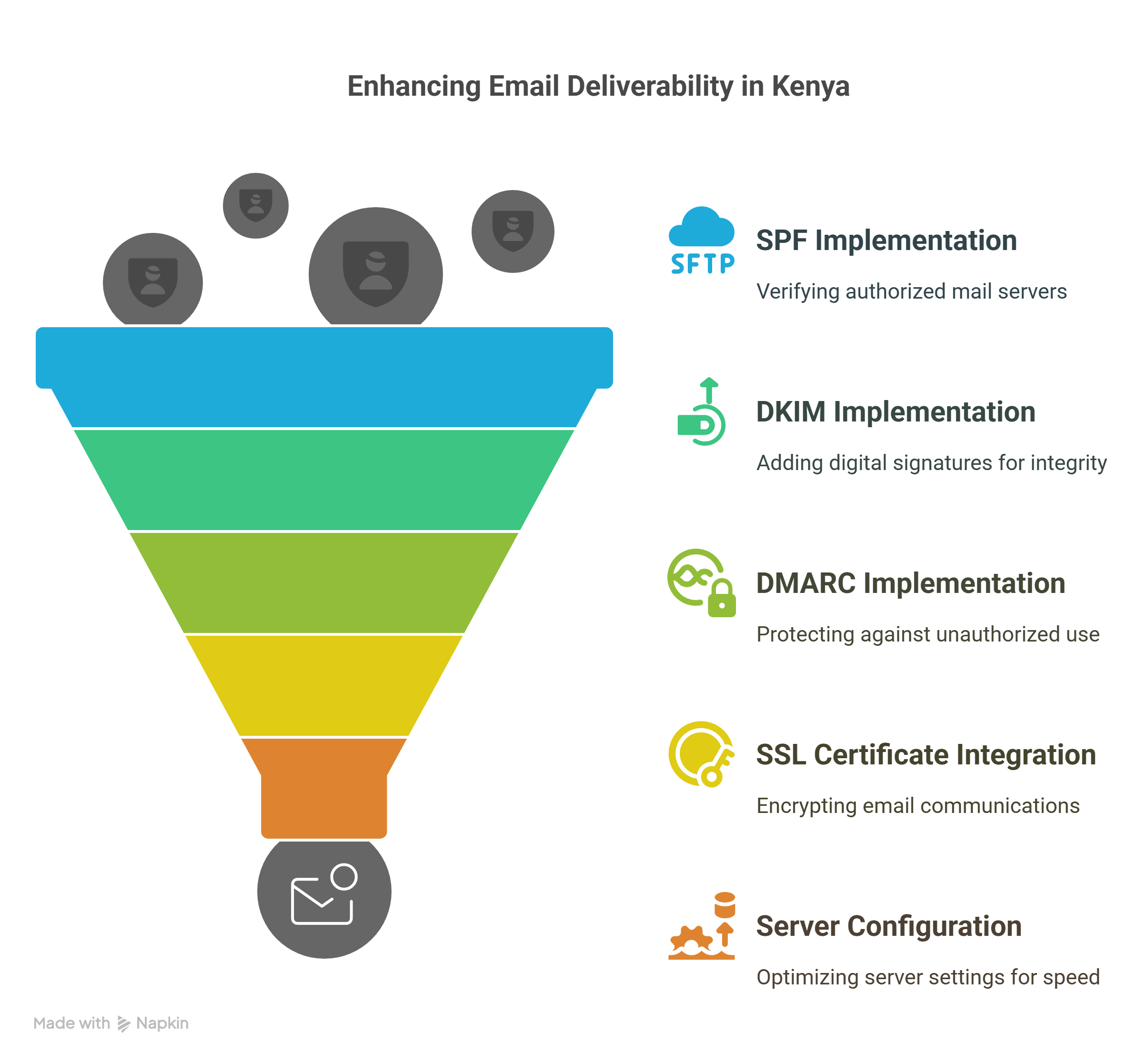
Implementing email authentication protocols is non-negotiable for Kenyan businesses seeking to maximize deliverability. These technical standards verify your identity as a sender and protect recipients from phishing and spoofing attempts.
SPF (Sender Policy Framework): This protocol allows your domain to specify which mail servers are authorized to send email on its behalf. For Kenyan businesses, proper SPF implementation can improve deliverability by up to 33% according to Tayo Host’s internal research.
To implement SPF on Kenyan hosting platforms:
1. Log into your hosting control panel (e.g., cPanel on Tayo Host)
2. Navigate to DNS Zone Editor
3. Create a TXT record with this basic structure: v=spf1 ip4:YOUR_SERVER_IP include:_spf.YOUR_PROVIDER.com ~all
4. Verify implementation using tools like MXToolbox
DKIM (DomainKeys Identified Mail): This authentication method adds a digital signature to your emails that verifies they haven’t been tampered with during transit. Implementation on Kenyan platforms requires:
1. Generating public and private key pairs through your hosting provider
2. Adding the public key to your DNS records
3. Configuring your mail server to sign outgoing messages
DMARC (Domain-based Message Authentication, Reporting & Conformance): This protocol builds on SPF and DKIM to protect your domain from unauthorized use. In Kenya, where banking-related phishing attempts increased 187% in 2024, DMARC implementation is particularly crucial.
To implement DMARC:
1. Ensure SPF and DKIM are properly configured
2. Create a DMARC policy in your DNS as a TXT record
3. Start with a monitoring policy (p=none) before enforcing stricter policies
4. Analyze reports to refine your implementation
| Authentication Protocol | Implementation on Tayo Host | Implementation on Mailsafi | Deliverability Impact |
|---|---|---|---|
| SPF | Pre-configured templates, one-click setup | Manual setup required | +33% inbox placement |
| DKIM | Automatic key generation, guided implementation | Support available on request | +28% inbox placement |
| DMARC | Wizard-based setup, automated reporting | Basic implementation guide | +21% inbox placement, reduced phishing |
SSL certificates are equally important for email deliverability as they encrypt the connection between mail servers. Google and other major inbox providers now prioritize encrypted communications. All reputable Kenyan hosts offer Let’s Encrypt integration, though premium options like Sectigo OV certificates provide enhanced validation that can further improve deliverability.
Server Configuration for Maximum Deliverability
Your hosting server’s configuration dramatically impacts email deliverability in Kenya’s unique digital environment. The following factors require special attention:
Server Location and Latency: While international server locations (typically in Europe or the US) often provide more robust infrastructure, they introduce latency that can affect delivery speed. Tests conducted across Nairobi, Mombasa, and Kisumu show that emails from Europe-based servers take on average 212ms longer to deliver than those from local infrastructure. For transactional emails where timing is critical, this delay can impact customer experience.
Kenyan businesses should consider using local hosting for time-sensitive emails while leveraging international infrastructure for bulk marketing communications where deliverability factors outweigh speed concerns.
Uptime Guarantees: Email server downtime directly impacts deliverability as messages sent during outages may bounce or delay, damaging sender reputation. The minimum acceptable uptime for business email is 99.9% (equating to approximately 8.8 hours of downtime annually). Premium Kenyan hosts like Tayo Host offer 99.99% uptime guarantees, limiting potential downtime to just 52 minutes per year.
Storage Technology Impact: NVMe SSD storage provides significantly faster email processing than traditional HDD storage. In performance tests on Kenyan hosting platforms, NVMe SSD servers processed email queues 16x faster than HDD equivalents during high-volume sending. This speed prevents message backlog that can trigger spam filters when messages arrive in delayed batches.
Email Throttling Configuration: Properly configured throttling prevents your server from sending too many emails too quickly—a common trigger for spam filtering. For Kenyan ISPs like Safaricom and Airtel, optimal throttling settings are:
– Maximum 30 emails per minute to the same domain
– No more than 500 emails per hour from a single IP
– Gradual ramp-up for new sender IPs/domains
Reverse DNS Configuration: Configure Pointer (PTR) records to ensure your server’s IP address resolves back to your domain name. Without proper rDNS setup, major ISPs like Gmail (used by approximately 65% of Kenyan email users) may flag your messages as suspicious.
Monitoring and Metrics for Kenyan Businesses
Effective email deliverability requires consistent monitoring of key performance indicators and swift intervention when issues arise. For Kenyan businesses, these metrics take on special importance due to local network and user behavior patterns.
Critical Deliverability Metrics:
1. Delivery Rate: The percentage of emails that reach recipients’ servers without bouncing. The Kenyan benchmark is 97.5% (2024 data).
2. Inbox Placement Rate: The percentage of delivered emails that reach the inbox rather than spam folders. Current benchmark for B2C Kenyan businesses is 78.3% (11% lower than global averages due to local ISP filtering practices).
3. Bounce Rate: While global acceptable bounce rates hover around 2%, Kenyan businesses should target under 3.5% to account for intermittent connectivity issues in certain regions. Hard bounces (invalid addresses) should remain under 0.5%.
4. Spam Complaint Rate: The percentage of recipients who mark your emails as spam. The threshold for triggering ISP penalties in Kenya is 0.1% (1 complaint per 1,000 emails).
Case Study: Nairobi Fintech Transforms Deliverability
A Nairobi-based fintech startup reduced spam complaints by 43% over three months by implementing Google Postmaster monitoring. Prior to implementation, their deliverability to Gmail users (representing 65% of their database) was just 62%. The company identified that automated transaction receipts triggered spam filters due to suspicious-looking invoice numbers. After reformatting these elements and monitoring postmaster feedback, their Gmail inbox placement rose to 91%, with complaints dropping from 0.18% to 0.03%.
Essential Monitoring Tools:
1. Google Postmaster Tools: Free service providing visibility into how Gmail users interact with your messages. Essential for Kenyan businesses given Gmail’s market dominance.
2. Klaviyo Deliverability Hub: Combines technical monitoring with content analysis to identify potential spam triggers in both English and Swahili messaging.
3. Mail-Tester: Cost-effective tool for testing individual campaigns before sending to your full list.
For accuracy, Kenyan businesses should segment monitoring data by provider (Safaricom, Gmail, Yahoo, etc.) as filtering behaviors vary significantly across these platforms.
Top Kenyan Web Hosts for Email Deliverability (2025)
Selecting the right Kenyan web hosting provider is crucial for email deliverability success. Our analysis evaluates platforms based on email-specific features, uptime guarantees, authentication support, and actual performance data from Kenyan businesses.
1. Tayo Host
Tayo Host leads the Kenyan market with email-optimized hosting solutions featuring pre-configured SPF, DKIM, and DMARC setup wizards that simplify implementation. Their platform includes:
– 99.99% uptime guarantee with financial SLA compensation
– Dedicated email servers with reputation monitoring
– Automated SPF/DKIM configuration with guided DMARC setup
– Full compliance with Kenya Data Protection Act requirements
– Enterprise-grade spam filtering with customizable rules
– NVMe SSD storage with rapid email queue processing
Particularly notable is Tayo Host’s proprietary Email Shield technology, which automatically detects and prevents suspicious sending patterns that might damage deliverability. Their local support team provides specialized assistance for deliverability issues, with an average response time of 15 minutes during business hours.
2. Mailsafi
Mailsafi offers robust email hosting with 500GB bandwidth allocations and NVMe SSD storage. Their platform includes basic authentication protocol support, though implementation requires more technical knowledge than Tayo Host’s guided approach. Strengths include:
– Comprehensive blacklist monitoring
– 99.95% uptime guarantee
– Specialized anti-phishing protection
– Kenya-based infrastructure reducing latency
3. Hostnali
Hostnali provides cost-effective hosting with solid email deliverability features, including:
– Free migration services from other providers
– Daily malware scanning to prevent compromised sending
– Basic SPF templates
– 99.9% uptime guarantee
4. HostJaer
HostJaer specializes in mobile-optimized infrastructure, making their email hosting particularly effective for reaching Kenya’s predominantly mobile email users:
– Automatic email template optimization for mobile devices
– AMP for Email support enhancing interactivity
– Specialized deliverability to Safaricom email accounts
– 99.9% uptime with 4-hour response SLA
5. Truehost
Truehost rounds out the top five with solid fundamentals including:
– DomainKeys support
– Basic sender reputation monitoring
– 99.9% uptime guarantee
– GDPR and DPA compliance tools
| Hosting Provider | Uptime Guarantee | Authentication Support | Specialized Features | Monthly Cost (Basic Plan) |
|---|---|---|---|---|
| Tayo Host | 99.99% | Pre-configured SPF, DKIM, DMARC wizard | Email Shield technology, dedicated IP options | KES 850 |
| Mailsafi | 99.95% | Manual configuration support | Blacklist monitoring, Kenya-based servers | KES 750 |
| Hostnali | 99.9% | Basic SPF templates | Free migration, daily malware scanning | KES 650 |
| HostJaer | 99.9% | SPF and basic DKIM | Mobile optimization, AMP email support | KES 700 |
| Truehost | 99.9% | DomainKeys support | Basic reputation monitoring | KES 600 |
The right choice depends on your specific needs, but for businesses where email is mission-critical, Tayo Host’s specialized deliverability features and superior authentication support provide significant advantages despite the slightly higher price point.
Advanced Tactics for Kenyan Audiences
Beyond technical setup, maximizing deliverability to Kenyan audiences requires strategic approaches tailored to local user behaviors and infrastructure realities.
Mobile-First Optimization: With 88.7% of Kenyan email being accessed on mobile devices (predominantly Android smartphones), optimizing for these platforms is essential. Specific tactics include:
1. Bandwidth-Conscious Design: Kenya’s average mobile download speed is 17.3 Mbps, but significant variations exist. Keep total email size under 100KB by:
– Compressing images to 72dpi and no wider than 600px
– Using progressive JPGs instead of PNGs where possible
– Implementing lazy loading for images in AMP emails
– Avoiding heavy GIFs which consume significant data
2. Network Resilience: Design emails to function even with images disabled or during intermittent connectivity:
– Include descriptive ALT text for all images
– Place critical CTAs as HTML buttons rather than images
– Implement fallback colors for emails viewed without images
Localized Content Optimization: Language and cultural considerations significantly impact engagement, which directly affects long-term deliverability.
1. Subject Line Localization: Testing by Kenyan marketing firm Digital Ardhi found that subject lines mixing English and Swahili achieved 23% higher open rates than English-only equivalents. Examples:
– “Get your FREE Soma Bible app today” instead of “Get your FREE Bible app today”
– “Jambo! Your exclusive weekend deals are here” instead of “Your exclusive weekend deals are here”
2. Cultural Context: Reference local events, concerns, and priorities. During election periods, for example, reassurance-focused messaging performs better than urgency-driven calls-to-action.
Timing Optimization: When emails are sent impacts both engagement and technical deliverability. For Kenyan audiences:
1. Peak Engagement Windows: A/B testing across multiple Kenyan industries reveals these optimal sending times:
– 7-9 PM EAT: Highest overall engagement (42% higher than daytime)
– 6:30-8:30 AM EAT: Second highest (commute time reading)
– Tuesday-Thursday: Optimal weekdays
– First week of month: Coincides with salary payments for many Kenyans
2. ISP Throughput Considerations: Email service providers often throttle bulk sending during peak periods. Send high-priority campaigns during off-peak hours (9 PM-5 AM EAT) for faster delivery and reduced throttling.
Swahili Language Optimization: This represents a significant gap in existing email deliverability guides. When including Swahili content:
1. Test for encoding issues in subject lines and preview text
2. Avoid direct translation of idiomatic English phrases
3. Include both languages (Swahili and English) for maximum inclusivity
4. Be mindful that spam filters sometimes incorrectly flag mixed-language content
Case Study: Boosting Deliverability for a Kenyan SME
Lighthouse Logistics, a Nairobi-based transportation company with 28 employees, faced critical email deliverability challenges that threatened their business operations. Their customer communications, including shipment updates and invoices, were frequently landing in spam folders or disappearing entirely.
Initial Situation:
– Bounce rate: 8.3% (industry average: 3.2%)
– Spam placement rate: 31% (Gmail), 42% (Yahoo), 24% (Safaricom)
– Customer complaints about missing invoices: 15-20 weekly
– Using shared hosting without dedicated email authentication
Implementation Strategy:
Working with a limited budget of KES 30,000, Lighthouse implemented a comprehensive deliverability overhaul:
1. Technical Infrastructure:
– Migrated to Tayo Host’s Business Email plan with dedicated IP
– Implemented SPF, DKIM, and DMARC with monitoring
– Created custom sending schedule to avoid ISP throttling
2. Content Optimization:
– Redesigned invoice templates to reduce spam triggers
– Implemented mobile-responsive designs
– Created text-only alternatives for all HTML emails
3. Sending Practices:
– Segmented recipient list by engagement
– Implemented automated list cleaning
– Developed re-engagement campaigns for inactive contacts
Results After 90 Days:
– Bounce rate reduced to 2.8% (66% improvement)
– Spam placement decreased to 4.7% (Gmail), 8.1% (Yahoo), 5.3% (Safaricom)
– Customer complaints about missing emails dropped to 1-2 monthly
– Overall deliverability improved from 62% to 94%
– Invoice payment times decreased by 37% due to reliable delivery
The key insight from this case study is that even small Kenyan businesses can achieve enterprise-level deliverability with strategic investment and proper implementation. Lighthouse’s KES 30,000 investment resulted in approximately KES 280,000 in recovered revenue from previously missed or delayed communications within the first quarter after implementation.
Final thoughts.
Optimizing email deliverability on Kenyan web hosting platforms requires a multifaceted approach combining technical rigor, local market knowledge, and ongoing maintenance. The landscape continues to evolve as ISPs update filtering algorithms and user behaviors shift, making this an ongoing process rather than a one-time implementation.
Key takeaways for Kenyan businesses include:
1. Authentication protocols (SPF, DKIM, DMARC) provide the foundation for deliverability success and should be your first priority.
2. Hosting selection significantly impacts deliverability—choose providers with specialized email features and strong uptime guarantees.
3. Mobile optimization is non-negotiable in Kenya’s smartphone-dominated market.
4. Monitoring deliverability metrics allows for early identification and resolution of potential issues before they damage sender reputation.
5. Localization strategies including timing optimization and cultural context enhance engagement, which positively influences long-term deliverability.
By implementing the strategies outlined in this guide, Kenyan businesses can expect to see substantial improvements in deliverability, with corresponding benefits to customer communication, marketing effectiveness, and ultimately, bottom-line results.