The History and Evolution of .so Domains: From Country Code to Global Usage.
The .so domain, originally designated as Somalia’s country code top-level domain (ccTLD), has undergone a remarkable transformation from its regional roots to global recognition.
This evolution reflects the dynamic nature of the internet and the adaptability of domain names in the digital age.
From its inception as a country-specific identifier to its current status as a versatile domain option for businesses and individuals worldwide, the .so domain exemplifies the changing landscape of online identities.
Did you know that .so domains are now used creatively by tech startups to form clever domain hacks like “do.so” or “say.so”?
This article will explore the fascinating journey of .so domains, tracing their history, global adoption, and future prospects in the ever-expanding digital realm.
History of Domain Names and TLDs
Pre-Domain Era and the Need for DNS
In the early days of the internet, computer networks relied solely on numerical IP addresses to identify and communicate with each other.
This system, while functional, was cumbersome and difficult for humans to remember or use effectively. As the network of connected computers grew, it became increasingly clear that a more user-friendly system was needed.
In 1981, David L. Mills proposed a hierarchical namespace in RFC 799, laying the groundwork for what would become the Domain Name System (DNS).
This proposal recognized the need for a structured approach to naming and addressing in the rapidly expanding digital landscape. The hierarchical structure would allow for easier management and scalability, crucial factors as the internet continued to grow.
The transition from IP addresses to domain names represented a significant leap in making the internet more accessible to the general public.
It marked the beginning of a new era where memorable names could be associated with online resources, paving the way for the internet as we know it today.
Introduction of the Domain Name System (DNS)
The Domain Name System (DNS) was formally introduced in 1983 through RFC 882, authored by Paul Mockapetris.
This groundbreaking development was the result of collaborative efforts by key figures in internet history, including Jon Postel and Craig Partridge.
The DNS provided a distributed database system for translating human-readable domain names into machine-readable IP addresses.
Prior to DNS, the internet relied on a centralized HOSTS.TXT file maintained by the Stanford Research Institute. This file contained a list of all known hosts and their corresponding IP addresses.
As the number of connected computers grew exponentially, this system became unsustainable.
The transition from HOSTS.TXT to DNS was a crucial step in the internet’s evolution. It allowed for decentralized management of domain names and IP addresses, enabling the rapid expansion of the internet.
The hierarchical structure of DNS made it possible to delegate responsibility for different parts of the namespace, facilitating more efficient management and growth.
Author’s Note: The introduction of DNS was a pivotal moment in internet history, comparable to the development of the printing press in its impact on information dissemination.
It laid the foundation for the modern internet, enabling the creation of user-friendly web addresses and paving the way for the digital revolution we experience today.
Emergence and Evolution of .so Domains
First Country-Code Top-Level Domains (ccTLDs)
The introduction of country-code Top-Level Domains (ccTLDs) in 1985 marked a significant milestone in the development of the internet’s addressing system.
The first ccTLDs to be introduced were .us for the United States, .uk for the United Kingdom, and .il for Israel. These domains were created to provide specific national identities within the global internet structure.
The allocation of ccTLDs was formalized in 1994 with the publication of RFC 1591, which outlined the structure and delegation procedures for domain names.
This document established the use of ISO 3166-1 alpha-2 country codes as the basis for ccTLDs, ensuring a standardized approach to country-specific domain allocation.
The introduction of ccTLDs played a crucial role in fostering the growth of local internet communities and facilitating the development of country-specific online services and content.
It also laid the groundwork for the later emergence of .so domains as Somalia’s designated ccTLD.
Specific History of .so Domains
The .so domain was officially designated as Somalia’s ccTLD in 1997, following the ISO 3166-1 alpha-2 country code standard. However, due to political instability and infrastructure challenges in Somalia, the practical implementation and management of .so domains faced significant hurdles in its early years.
The administration of .so domains has undergone several changes since its inception. Initially, it was managed by the World Internetworking Authority, but control was later transferred to the Somali Ministry of Post and Telecommunications.
In 2009, the management was delegated to the .SO Registry, which aimed to modernize and expand the use of .so domains.
A significant milestone in the history of .so domains occurred in 2010 when they became available for public registration. This opening up of .so domains to global users marked the beginning of their transformation from a purely country-specific identifier to a more versatile domain option with international appeal.
Author’s Note: The evolution of .so domains from a sparsely used ccTLD to a globally recognized domain option is a testament to the adaptability of internet infrastructure in the face of changing geopolitical and technological landscapes.
Global Usage and Expansion
Expansion of TLDs and Global Internet Growth
The expansion of Top-Level Domains (TLDs) has been a key factor in the global growth of the internet. Initially limited to a handful of generic TLDs (gTLDs) like .com, .org, and .net, the domain landscape has undergone significant diversification.
The introduction of new generic TLDs (ngTLDs) in 2013 by ICANN opened up a vast array of possibilities, with hundreds of new domain extensions becoming available.
This expansion has had a profound impact on global internet usage and domain registration patterns. It has provided businesses and individuals with more options to create memorable and relevant online identities.
For instance, industry-specific TLDs like .tech, .shop, and .blog have allowed for more targeted branding strategies.
The proliferation of TLDs has also contributed to increased competition in the domain market, often leading to more affordable registration options and improved services for end-users.
This democratization of domain names has played a crucial role in fostering internet adoption and digital presence across diverse global communities.
.so Domains in the Global Context
The .so domain has carved out a unique niche in the global domain landscape, transcending its original purpose as Somalia’s ccTLD.
Its adoption by international users has been driven by several factors, including its versatility for creative domain hacks and its association with modern, tech-savvy brands.
Many global businesses and organizations have embraced .so domains for their online presence. For example, the popular link-shortening service “is.gd” uses “v.gd” as an alternative domain, leveraging the .so extension creatively.
Similarly, “do.so” has been used by productivity apps and services, capitalizing on the natural language flow of the domain.
The startup community has shown particular affinity for .so domains. Companies like “on.so”, a digital marketing platform, and “book.so”, an online booking system, demonstrate how .so can be effectively used for brandable, concise domain names in the tech sector.
Case Study: Buffer’s Use of buff.ly
Buffer, a social media management platform, successfully uses the .so domain in their URL shortener, “buff.ly”. This creative use of the .so domain (in combination with the .ly TLD) showcases how global companies can leverage country-code domains for branding purposes beyond their original geographic context.
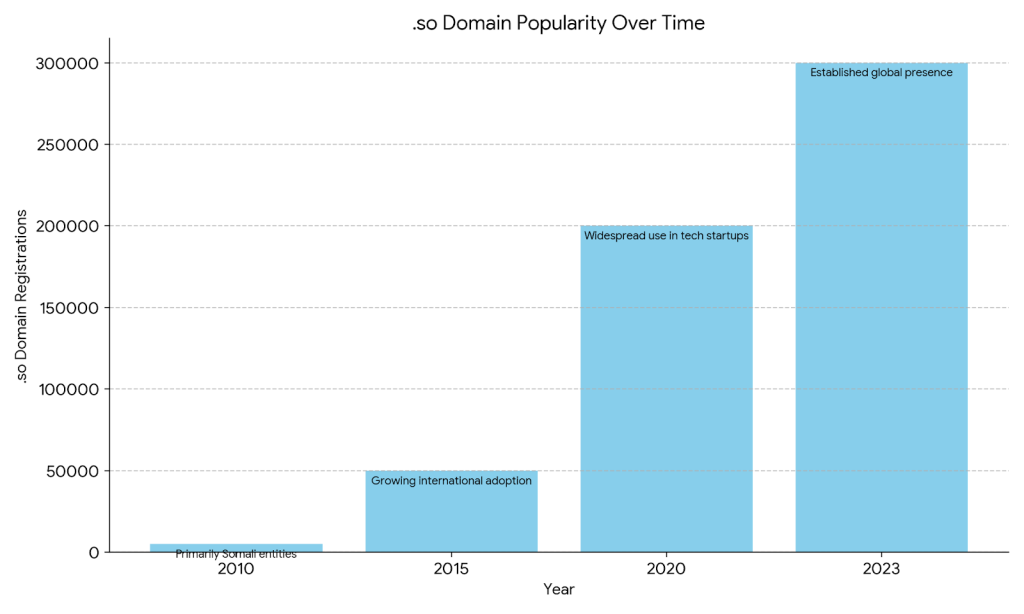
| Year | .so Domain Registrations | Notable Usage |
|---|---|---|
| 2010 | ~5,000 | Primarily Somali entities |
| 2015 | ~50,000 | Growing international adoption |
| 2020 | ~200,000 | Widespread use in tech startups |
| 2023 | ~300,000 | Established global presence |
Author’s Note: The global adoption of .so domains illustrates the fluid nature of internet identities, where the original geographic associations of ccTLDs can evolve into broader, more creative uses in the global digital ecosystem.
Challenges and Regulations
Domain Industry Challenges
The domain industry faces several ongoing challenges, with cybersquatting and domain disputes being among the most prominent.
Cybersquatting, the practice of registering domain names that are similar to existing trademarks or popular brands with the intent to profit from them, has been a persistent issue since the early days of the commercial internet.
To address these challenges, various policies and regulations have been implemented. The Uniform Domain-Name Dispute-Resolution Policy (UDRP), established by ICANN in 1999, provides a streamlined process for resolving disputes between trademark holders and domain name registrants.
Additionally, many countries have enacted specific laws to combat cybersquatting, such as the U.S. Anticybersquatting Consumer Protection Act (ACPA) of 1999.
Illegal activities conducted through domain names, including phishing, malware distribution, and hosting of illegal content, pose another significant challenge.
Registries and registrars are increasingly implementing proactive measures to detect and prevent such abuses, often in cooperation with law enforcement agencies and cybersecurity firms.
Specific Challenges for .so Domains
.so domain registrants face unique challenges stemming from the domain’s dual identity as both a country-code TLD and a popular choice for global users.
One primary challenge is navigating the complex interplay between international domain regulations and local Somali laws governing the .so ccTLD.
Compliance with international standards while respecting local regulations can be a delicate balance for .so domain holders.
For instance, dispute resolution processes may need to consider both ICANN’s UDRP and any specific policies set by the Somali domain authority.
Another challenge is the potential for geopolitical instability in Somalia to impact the management and perception of .so domains.
While the global usage of .so has largely mitigated this concern, it remains a factor for businesses considering long-term investment in .so domains.
Author’s Note: The evolution of .so domains from a purely Somali ccTLD to a globally used domain extension presents a fascinating case study in the adaptability of internet governance structures.
It highlights the need for flexible regulatory frameworks that can accommodate the global nature of the internet while respecting national sovereignty.
Modern Trends and Future Outlook
Technological Advancements in Domain Management
Recent years have seen significant technological advancements in domain management, enhancing security, privacy, and user experience.
DNS over HTTPS (DoH) and DNS over TLS (DoT) are two notable innovations that encrypt DNS queries, protecting users from eavesdropping and manipulation of DNS data.
DoH, which sends DNS queries over HTTPS, offers improved privacy and security by preventing ISPs from seeing which websites users are accessing.
DoT provides similar benefits by encrypting DNS queries over a TLS connection. These technologies are gradually being adopted by major browsers and operating systems, signaling a shift towards more secure domain resolution practices.
Another emerging trend is the development of blockchain-based domains. These decentralized domain systems, such as those built on Ethereum, offer censorship resistance and eliminate the need for central authorities in domain management.
While still in their early stages, blockchain domains represent a potential paradigm shift in how we think about and manage internet naming systems.
Future of .so Domains
The future of .so domains looks promising, with several trends pointing towards continued growth and diversification in usage.
As the global tech startup ecosystem expands, the demand for short, memorable domain names is likely to drive further adoption of .so domains for creative branding purposes.
Marketing and branding opportunities with .so domains are expected to evolve, potentially seeing increased use in industry-specific contexts.
For instance, software-as-a-service (SaaS) companies might leverage domains like “software.so” or “cloud.so” to create strong, relevant online identities.
The integration of .so domains with emerging technologies like IoT (Internet of Things) and AI-driven platforms could open up new avenues for usage.
We might see .so domains being used for smart device naming conventions or as identifiers in machine-to-machine communications.
Author’s Note: The future of .so domains will likely be shaped by the broader trends in internet technology and user behavior. As the lines between different TLDs continue to blur in terms of perception and usage, .so domains are well-positioned to maintain their appeal as versatile, globally-recognized domain options.
Conclusion
The journey of .so domains from a country-specific ccTLD to a globally recognized and creatively used domain extension exemplifies the dynamic nature of the internet.
From its origins as Somalia’s digital identifier to its current status as a favorite among tech startups and innovative businesses, the .so domain has demonstrated remarkable adaptability.
The challenges faced, including regulatory complexities and the need to balance local and global interests, have been met with resilience and innovative solutions.
As we look to the future, .so domains are poised to continue their evolution, potentially playing significant roles in emerging technologies and digital branding strategies.
The story of .so domains serves as a microcosm of the internet’s own history – one of constant change, global connection, and the breaking down of traditional boundaries.